Luxury interiors are often defined by the details that cannot be replicated through ordinary decoration. The natural character of stone, the precision of artistic workmanship and the relationship between materials can transform an interior into a distinctive architectural experience. Bespoke marble inlay brings these elements together, turning marble surfaces into carefully composed works of art.
Rooted in the historic tradition of Pietra Dura, marble inlay combines natural marble with individually shaped pieces of coloured stone to create intricate patterns, floral compositions, geometric arrangements and original artistic designs. In India, this craft is closely associated with Agra, where the stone inlay traditions seen in Mughal architecture continue to inspire contemporary design.
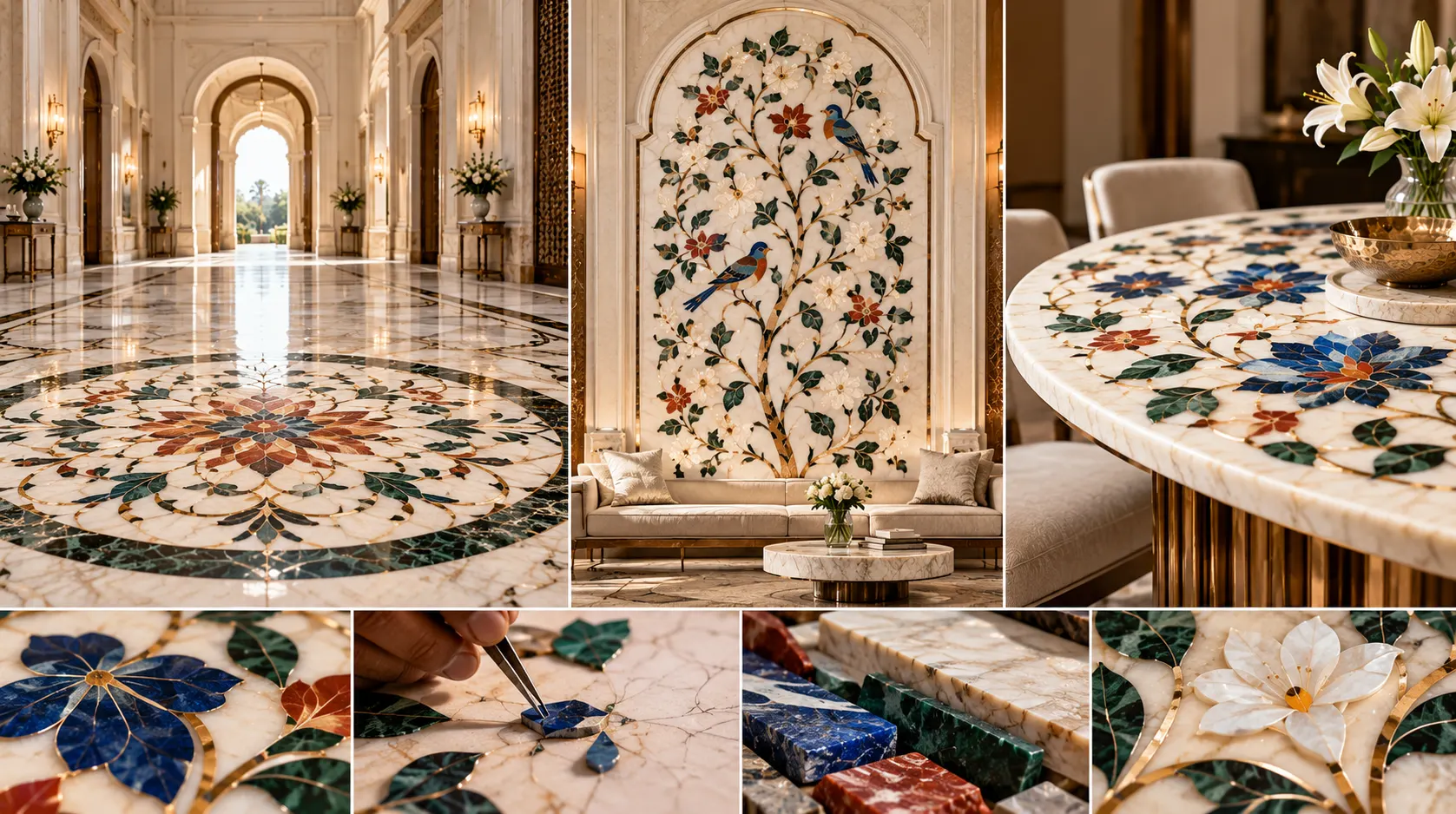
Today, custom marble inlay is finding its place in luxury residences, boutique hotels, private villas and sophisticated commercial interiors. From statement flooring and decorative wall panels to distinctive tabletops, each application offers an opportunity to introduce artistic detail that responds to the character of a particular space.
Unlike standard decorative finishes, bespoke marble inlay begins with the project itself. The dimensions, materials, colours, patterns and intended application are considered together, allowing the finished design to complement the architecture rather than simply occupy it.
What Is Bespoke Marble Inlay?
Bespoke marble inlay is a customised decorative technique in which pieces of coloured stone are carefully fitted into a marble surface to create a specific design. The term bespoke refers to the individual nature of the design, developed around particular dimensions, aesthetic preferences and project requirements.
The technique draws on the principles of Pietra Dura, an art form historically associated with intricate stone compositions. Each element of the design is shaped to fit a corresponding recess in the marble, creating a detailed pattern from the natural colours and characteristics of the selected materials.
A bespoke composition may feature traditional botanical motifs, symmetrical geometric patterns, ornamental borders or contemporary abstract forms. Some designs use a restrained palette of neutral stones, while others combine contrasting colours to create a more expressive visual statement.
The defining feature is the relationship between the artwork and its intended setting. A marble inlay floor medallion may be designed around the proportions of an entrance hall, while a decorative wall panel may take its inspiration from the room’s architectural lines. A custom tabletop, meanwhile, can incorporate a pattern that follows the shape and scale of the furniture.
This flexibility makes bespoke marble inlay particularly suitable for interiors where individuality, material quality and detailed craftsmanship are important considerations.
Bespoke Marble Inlay: A Comparison of Floors, Walls and Tabletops
Although the same artistic tradition can inform all three applications, each surface presents different design considerations.
| Feature | Custom flooring | Wall panels | Tabletops |
|---|---|---|---|
| Primary role | Architectural surface and decorative focal point | Artistic feature and wall decoration | Functional furniture surface with decorative detail |
| Common designs | Medallions, borders and geometric patterns | Floral compositions, botanical art and abstract designs | Central motifs, borders and compact compositions |
| Key consideration | Traffic, installation and surface performance | Wall proportions, viewing distance and lighting | Furniture dimensions, edge treatment and everyday use |
| Planning priority | Floor layout and installation coordination | Panel dimensions and relationship to architecture | Pattern scale and intended furniture application |
This comparison highlights why a bespoke approach is valuable. Each application benefits from a design that responds to its specific requirements rather than simply reproducing the same pattern across different surfaces.
Why Choose Custom Marble Inlay for Luxury Interiors?
Luxury interior design increasingly values materials that contribute more than surface decoration. Natural stone offers texture, variation and a sense of permanence, while artistic inlay introduces colour, pattern and visual complexity.
Custom marble inlay brings these qualities together in a form that can be adapted to the requirements of an individual project.
A Design Created Around Your Space
One of the principal advantages of bespoke marble inlay is the ability to develop a composition for a specific architectural setting.
A large entrance hall may call for a circular medallion, while an elongated corridor may benefit from a linear pattern or decorative border. A feature wall can accommodate a large-scale botanical composition, whereas a coffee table may require a more compact arrangement.
Custom dimensions and proportions help ensure that the finished artwork feels integrated with the space.
The Character of Natural Materials
Marble and coloured stones possess natural variations in tone, veining and texture. These characteristics contribute to the individuality of an inlay composition.
Materials such as onyx, lapis lazuli, green aventurine, jasper and mother of pearl can be considered where their appearance and physical properties suit the design.
The choice of stone influences the overall atmosphere of the interior, from subtle and understated to richly detailed and dramatic.
A Connection Between Heritage and Contemporary Design
Marble inlay has a long association with Indian architectural heritage, particularly the decorative stonework of Agra. Yet the technique is not limited to traditional interiors.
Contemporary geometric patterns, simplified floral motifs and carefully balanced colour combinations can introduce the craft into modern residences and hospitality spaces.
This ability to bridge historical artistry and contemporary architecture gives bespoke marble inlay its distinctive appeal.
Custom Marble Inlay Flooring: Art Beneath Your Feet
Flooring is one of the largest continuous surfaces within an interior, making it an important opportunity for architectural expression. Bespoke marble inlay flooring introduces decorative detail directly into this surface, allowing the floor to become an integral part of the overall design.
Marble Floor Medallions
A marble floor medallion can create a focal point in a grand entrance, foyer, reception area or spacious living room.
Circular floral arrangements, symmetrical patterns and ornamental compositions can establish a sense of order and visual balance. The design may reference traditional architectural motifs or adopt a more restrained contemporary aesthetic.
The diameter, pattern and colour palette should be selected according to the dimensions of the room and the surrounding flooring.
Decorative Borders and Geometric Patterns
Custom marble inlay borders can define the edges of a room, frame a central area or create a transition between different flooring materials.
Geometric designs offer another approach, introducing rhythm and repetition without relying on elaborate ornamentation. They can be particularly effective in interiors where clean architectural lines are an important part of the design.
Flooring for Villas, Hotels and Grand Entrances
In luxury villas and hospitality environments, marble inlay flooring can help establish the identity of an entrance or reception space.
The design should be planned alongside the overall floor layout, including panel dimensions, joints, installation conditions and the requirements of the supporting surface. Areas exposed to frequent foot traffic require particular attention to suitable stone selection, finishing and maintenance.
The objective is to create a decorative floor that complements the architecture while meeting the practical demands of the space.
Bespoke Marble Inlay Wall Panels: Creating Architectural Focal Points
Walls provide an opportunity to display marble inlay as an artistic composition. Unlike smaller decorative objects, a custom marble wall panel can become a defining feature of an entire room.
Floral and Botanical Marble Wall Art
Floral compositions are among the most recognisable forms of traditional stone inlay. Leaves, petals and flowing stems can be constructed from coloured stones to create intricate designs against a marble background.
Depending on the scale and colour palette, a floral panel may introduce classical elegance, subtle ornamentation or a more dramatic artistic statement.
Contemporary Marble Inlay Panels
Bespoke marble inlay is equally suited to contemporary designs. Geometric arrangements, abstract patterns and simplified motifs can complement modern furniture, architectural lighting and understated finishes.
A restrained composition may rely on the natural contrast between the marble base and a small number of coloured stones rather than an elaborate pattern.
Where Can Marble Inlay Wall Panels Be Used?
Custom marble wall panels can be considered for living rooms, entrance halls, formal dining spaces, luxury bedrooms, hotel lobbies and selected commercial interiors.
Their placement should reflect the proportions of the wall, the available viewing distance and the surrounding architecture. Lighting can also influence how the stone colours and surface details are perceived.
For larger projects, the composition may be divided into carefully coordinated panels or developed as part of a broader decorative scheme.
Explore marble inlay wall art at Zenvira Atelier:
https://zenviraatelier.com/subcategory/wall-art
Custom Marble Inlay Tabletops: Functional Surfaces with Artistic Detail
A marble inlay tabletop combines the practical role of furniture with the visual qualities of decorative stonework. Because the surface is viewed at close range, the relationship between the pattern, the marble background and the furniture’s proportions is especially important.
Dining and Coffee Tables
A custom dining table may feature a central motif, a decorative border or a more extensive stone composition. The pattern can be developed around the shape of the tabletop, whether round, oval, square or rectangular.
Coffee tables often benefit from designs that can be appreciated from different viewing angles. A balanced central composition or a restrained ornamental pattern can complement the furniture without overwhelming it.
Console and Accent Tables
Console tables and occasional furniture offer opportunities for more distinctive decorative treatments. A carefully positioned inlay pattern can become a focal point in an entrance, living area or formal sitting room.
The choice of marble, stone colours, edge treatment and overall dimensions should reflect the intended setting.
Designing for Everyday Use
Although marble inlay tabletops are decorative, their practical requirements should not be overlooked. The intended use, exposure to spills, cleaning methods and suitable surface protection must be considered during planning.
The right combination of design and finishing allows the artwork to remain visually coherent while serving its intended function.
Discover handcrafted marble tabletops at Zenvira Atelier:
https://www.zenviraatelier.com/subcategory/handcrafted-marble-table-top
Materials and Colours: Defining the Character of Bespoke Inlay
The material palette is one of the most influential decisions in a custom marble inlay project. The combination of background marble and coloured stones determines the contrast, mood and visual rhythm of the finished composition.
White and ivory marble can provide a light, refined background. Darker marble may create a more dramatic setting for contrasting inlay. Beige and other neutral tones can complement interiors that rely on warm materials and subtle colour transitions.
Coloured stones introduce additional possibilities. Lapis lazuli can contribute deep blue accents, green aventurine can complement botanical motifs, and onyx can provide distinctive colour variations. Mother of pearl may be used in selected designs for its iridescent appearance.
The choice should consider not only colour but also the scale of the pattern and the natural variation of the materials.
| Design element | Possible approach | Suitable application |
|---|---|---|
| Marble background | White, ivory, beige or darker marble | Floors, walls and tabletops |
| Colour palette | Neutral tones, contrasting colours or botanical shades | Classical and contemporary interiors |
| Pattern | Floral, geometric, ornamental or abstract | Custom panels and architectural surfaces |
| Decorative detailing | Stone borders, central motifs and medallions | Entrances, feature walls and furniture |
| Project dimensions | Developed around the intended surface | Bespoke residential and hospitality projects |
The most successful compositions balance these elements rather than treating each decision separately. A thoughtful material palette allows the inlay to complement the architecture and maintain a coherent visual identity.
The Process of Creating Bespoke Marble Inlay
Every custom marble inlay project begins with an understanding of the space and the desired artistic result. The process involves several connected stages, each contributing to the quality of the finished work.
Design development: The pattern, dimensions and overall composition are established in relation to the project requirements.
Material selection: Suitable marble and coloured stones are chosen according to their appearance, physical characteristics and intended application.
Stone cutting and shaping: Individual pieces are prepared to correspond to the details of the design.
Surface preparation and fitting: Recesses are created in the marble base, and the shaped pieces are carefully positioned and secured.
Finishing and inspection: The surface is finished according to the intended use, and the completed composition is checked for alignment, consistency and quality.
The level of complexity varies significantly between projects. A simple geometric border and a detailed botanical wall panel require different amounts of planning and execution.
For architectural installations, accurate measurements, panel layouts, handling requirements and installation coordination are particularly important. These considerations should be addressed early to help ensure that the completed artwork fits the intended setting.
Choosing the Right Bespoke Marble Inlay for Your Project
Selecting a custom marble inlay design involves balancing visual preferences with architectural and practical requirements.
Begin by identifying the role of the artwork. A floor medallion may be intended to establish a focal point, while a wall panel can introduce colour and artistic detail. A tabletop needs a composition that complements both the furniture and its intended use.
Next, consider the surrounding materials. Marble inlay should work with the flooring, wall finishes, furniture, lighting and overall colour palette rather than compete with them.
Scale is equally important. Intricate patterns may require sufficient viewing distance to be appreciated, while smaller surfaces often benefit from a more focused composition.
Finally, discuss material suitability, installation requirements and maintenance. Flooring, wall panels and tabletops experience different conditions and should be planned accordingly.
“True luxury is not simply about the materials we choose, but about the thought and craftsmanship that give those materials meaning.”
This principle is especially relevant to bespoke stonework. The quality of a finished composition depends on how effectively its materials, proportions and details work together.
Zenvira Atelier: Bespoke Marble Inlay for Refined Interiors
Based in Agra, India, Zenvira Atelier focuses on marble inlay design for walls, floors and tabletops, bringing the visual language of traditional stone craftsmanship into contemporary architectural settings.
The atelier’s approach centres on the relationship between natural materials, artistic composition and the character of the space. Bespoke design offers the opportunity to consider dimensions, patterns, stone combinations and colour palettes in relation to a particular project.
For architects, interior designers, hospitality professionals and homeowners, marble inlay can introduce a distinctive artistic element into an interior, whether through a statement floor medallion, a decorative wall panel or a custom tabletop.
At Zenvira Atelier, the enduring appeal of marble inlay lies in its ability to bring together heritage, material character and contemporary design. Each application offers a different way to explore the possibilities of stone as an architectural and artistic medium.
“When stone becomes a canvas for craftsmanship, even a single surface can give an entire space its identity.”
Discover how bespoke marble inlay can complement your next interior project, from custom floors and decorative wall panels to artistic tabletops.
Explore the collections at Zenvira Atelier: https://zenviraatelier.com/
For project enquiries, visit the website to connect with the atelier and discuss your requirements for bespoke marble inlay design.
FAQS
1. What is bespoke marble inlay?
Bespoke marble inlay is a customised decorative technique in which carefully cut pieces of coloured marble, natural stone and semi-precious materials are fitted into a marble surface to create unique patterns, motifs and artistic compositions. Unlike standard designs, bespoke marble inlay is tailored to the client’s preferred dimensions, materials, colours and interior design requirements.
2. How is custom marble inlay used in luxury interiors?
Custom marble inlay is used to enhance luxury interiors through decorative flooring, statement walls, artistic tabletops and architectural features. Popular applications include marble inlay wall panels, floor medallions, dining tables, reception areas and bespoke decorative installations for luxury residences, hotels and commercial spaces.
3. What is the difference between marble inlay and Pietra Dura?
Marble inlay is a broad term for decorative designs created by embedding contrasting materials into a marble surface. Pietra Dura is a traditional form of stone inlay known for intricate compositions made with precisely cut coloured stones. Both techniques can be used to create detailed floral patterns, geometric designs and bespoke artwork for luxury interiors.
4. Which materials are used for bespoke marble inlay designs?
Bespoke marble inlay designs may incorporate white marble, Dark Emperador marble, onyx, lapis lazuli, green aventurine, agate, jasper and other coloured natural stones. Mother-of-pearl and other decorative materials may also be used, depending on the design. Material selection depends on the desired aesthetic, application, durability and overall project specifications.
5. Can marble inlay be customised for walls, floors and tabletops?
Yes. Marble inlay can be customised for all three applications. Wall installations can feature artistic panels and decorative murals, flooring can incorporate intricate borders and medallions, and tabletops can display floral, geometric or bespoke artistic compositions. Dimensions, patterns, stone combinations and finishes can be selected according to the project’s design requirements.
6. How much does bespoke marble inlay cost?
The cost of bespoke marble inlay varies according to the dimensions, design complexity, types of stone, quantity of detailed inlay work and installation requirements. Simple geometric patterns may be less expensive than intricate floral compositions or large custom wall installations. For an accurate estimate, the intended application, dimensions, design references and material preferences should be assessed.
7. Is bespoke marble inlay suitable for modern luxury interiors?
Yes. Although marble inlay has a rich heritage, it works beautifully in contemporary interiors. Minimalist geometric patterns, abstract compositions, subtle stone contrasts and large-scale decorative panels can complement modern architecture. Carefully selected colours and patterns help integrate traditional craftsmanship into contemporary residences, boutique hotels, premium offices and hospitality projects.
8. How do you choose the right marble inlay design for a luxury interior?
Start by considering the interior’s architectural style, colour palette, lighting, available surface area and intended use. Floral and ornamental motifs can complement classic interiors, while geometric and abstract patterns often suit contemporary spaces. It is also important to select appropriate stones, confirm dimensions and coordinate the design with surrounding flooring, furniture and wall finishes.
9. How do you maintain bespoke marble inlay floors, walls and tabletops?
Clean marble inlay surfaces with a soft cloth or mop and a pH-neutral stone cleaner. Avoid acidic products, harsh chemicals and abrasive cleaning tools. For flooring, use suitable protective measures in high-traffic areas; for tabletops, promptly wipe spills and use coasters where appropriate. Professional guidance may be beneficial for large installations or specialised stone finishes.
10. Where can you explore bespoke marble inlay for luxury interiors in India?
Agra, India, is renowned for its traditional marble inlay craftsmanship. Buyers, interior designers, architects and hospitality professionals can explore specialist ateliers offering customised stone inlay for architectural and decorative applications. Zenvira Atelier focuses on marble inlay for walls, floors and tabletops, offering design-led solutions that bring traditional stone artistry into contemporary luxury interiors.