
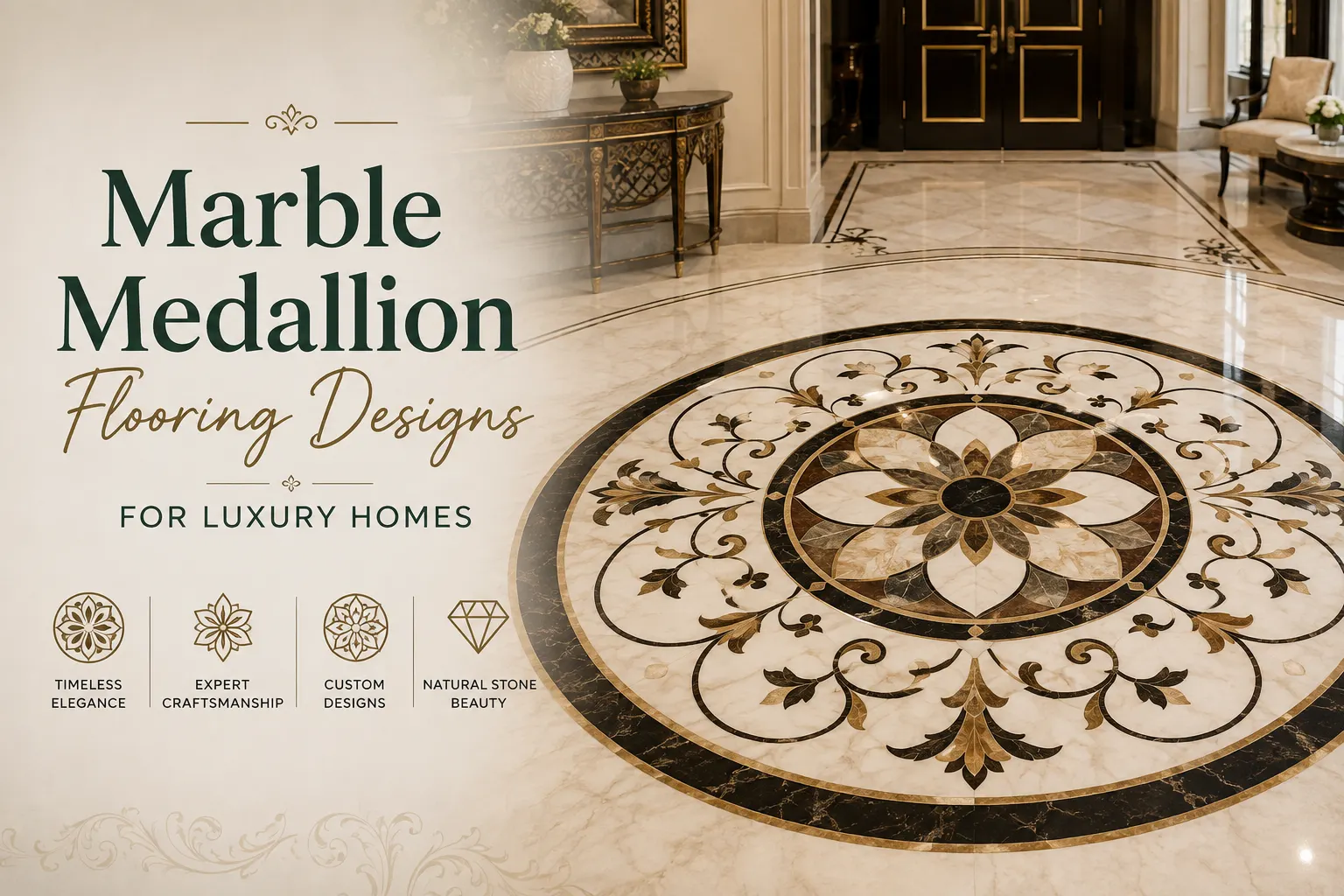
Luxury flooring is no longer just about choosing an expensive marble or a polished surface. In high-end interiors, flooring can become an important part of the overall design, adding character, artistry, and a sense of individuality to the space. This is where marble medallion flooring makes a remarkable difference.
A marble floor medallion is a decorative artwork created by combining carefully selected pieces of marble and, in some designs, semi-precious stones to form a central motif or detailed geometric composition. Unlike regular marble flooring, a medallion can become the visual focal point of a room, drawing attention to the entrance, living area, foyer, staircase, or other architectural spaces.
The appeal of these designs comes from the combination of natural stone and skilled craftsmanship. Each piece of marble is carefully selected, cut, shaped, and fitted into the overall pattern. Traditional Pietra Dura and marble inlay techniques can be used to create floral motifs, geometric patterns, compass designs, arabesques, borders, and completely custom artwork.
For luxury homeowners, architects, and interior designers, marble medallions also offer an opportunity to personalize a space. A design can be created specifically around the dimensions, architecture, color palette, and furniture of a project rather than choosing a standard flooring pattern.
In this guide, we’ll explore everything you need to know about marble medallion flooring designs for luxury homes—from their history and materials to popular designs, manufacturing techniques, customization options, pricing factors, installation considerations, and maintenance. We’ll also look at why handcrafted Indian marble inlay continues to be valued in premium residential and hospitality interiors.
What Is Marble Medallion Flooring?
Marble medallion flooring is a decorative flooring technique in which carefully cut pieces of marble are arranged to create a central artistic design within a larger floor. Instead of having a plain, continuous marble surface, a medallion introduces a detailed focal point that can define the character of an entrance, foyer, living room, hallway, or other luxury interior.
A typical marble floor medallion may feature geometric patterns, floral motifs, compass designs, borders, arabesques, or custom artwork. Depending on the design, different colors and varieties of marble can be combined to create contrast and depth. Semi-precious stones or materials such as lapis lazuli, malachite, jasper, agate, and Mother of Pearl may also be incorporated into more elaborate marble inlay flooring.
How Does a Marble Medallion Work?
A medallion is generally designed as a separate decorative composition that is integrated into the surrounding floor. It can be circular, oval, square, rectangular, or created in a completely custom shape depending on the architecture.
For example, a large round medallion can be positioned in the center of a foyer, while a rectangular inlay design may be used to emphasize a long entrance or hallway.
| Feature | Description |
|---|---|
| Main Material | Natural marble selected according to the design and application |
| Design | Floral, geometric, compass, arabesque, traditional, or contemporary |
| Inlay Materials | Contrasting marble, semi-precious stones, shells, or other decorative materials |
| Shape | Round, oval, square, rectangular, or fully customized |
| Craftsmanship | Pieces are precisely cut, fitted, finished, and polished |
| Application | Foyers, entrances, living rooms, halls, staircases, villas, hotels, and luxury commercial spaces |
Marble Medallion vs. Regular Marble Flooring
The main difference is the level of visual detail and craftsmanship. Regular marble flooring typically uses slabs or tiles arranged in a consistent layout. A medallion introduces a carefully planned artistic element into that flooring.
For luxury interiors, this can create a strong focal point without requiring decorative elements throughout the entire floor. A single handcrafted medallion can provide enough visual interest to make a large entrance or room feel distinctive.
What Makes Handmade Medallions Special?
Handcrafted marble medallions are created by artisans who work with individual pieces of stone rather than simply printing a design onto the surface. Each component must be cut and positioned accurately to create the intended composition.
Natural variations in marble also mean that every completed medallion can have its own subtle character. Even when the same design is reproduced, differences in stone tone and veining can make each installation slightly unique.
This is particularly valuable for luxury homes where homeowners and designers are looking for custom marble flooring rather than mass-produced decorative patterns.
Whether inspired by traditional Pietra Dura, classical geometric artwork, or contemporary interior design, marble medallion flooring offers a way to turn a functional floor into a distinctive piece of architectural art.
History of Marble Medallion & Pietra Dura Art
The history of marble medallion flooring is closely connected with the broader tradition of decorative stonework known as Pietra Dura. For centuries, artisans across different cultures have used carefully cut pieces of stone to create geometric patterns, floral artwork, borders, and architectural decoration. Over time, these techniques evolved from monumental architecture into sophisticated flooring, furniture, and interior décor.
From Europe to India
The term Pietra Dura comes from Italian and refers to the use of precisely cut and fitted hard stones to create decorative images and patterns. The technique became particularly refined in Italy during the Renaissance, where artisans created intricate stone compositions for palaces, churches, furniture, and architectural interiors.
The tradition later became influential in the Mughal courts of India, where European decorative techniques were adapted to Indian artistic traditions. Indian artisans developed their own distinctive approach to marble inlay, often known as Parchin Kari, combining white marble with colorful stones to create intricate floral and geometric designs.
The Mughal Influence
The Mughal period played an important role in the development of India’s marble inlay tradition. White marble was used extensively in monumental architecture, while contrasting stones were introduced to create decorative patterns.
The Taj Mahal in Agra is perhaps the most famous example. Its marble surfaces feature intricate floral and geometric inlay work using contrasting stones, demonstrating the extraordinary precision achieved by Indian artisans.
This tradition established Agra as an important center for marble inlay craftsmanship. Generations of artisans continued refining the techniques of stone cutting, fitting, polishing, and decorative design.
From Architecture to Flooring
As marble craftsmanship developed, decorative inlay moved beyond walls and monuments into floors and other architectural surfaces. Marble medallions became a particularly effective way to introduce detailed artwork into large flooring areas.
A medallion could serve as a visual centerpiece, often positioned at the center of an entrance hall, grand foyer, palace room, or other important architectural space.
Traditional designs commonly included:
- Floral motifs
- Geometric patterns
- Star and compass designs
- Arabesques
- Borders and frames
- Symmetrical compositions
- Decorative central motifs
The use of contrasting marble colors and semi-precious stones allowed artisans to create designs with remarkable visual depth.
Pietra Dura in Modern Luxury Interiors
Today, the principles of traditional Pietra Dura continue to influence contemporary marble medallion flooring designs. While historic artwork often followed elaborate traditional patterns, modern designers increasingly combine traditional craftsmanship with minimalist geometry, abstract compositions, and custom architectural motifs.
A contemporary marble medallion might use only two or three marble tones, creating a subtle design that complements modern furniture. A more traditional luxury interior may use multiple colors and semi-precious stones to create a richly detailed composition.
A Living Craft Tradition
The significance of marble medallions today lies not only in their appearance but also in their connection to traditional craftsmanship. A handmade medallion requires careful planning, precise stone cutting, accurate fitting, and detailed polishing.
For luxury homeowners, architects, and interior designers, this makes a custom marble medallion more than a flooring element. It becomes a piece of architectural art that connects historical stone craftsmanship with contemporary interior design.
| Historical Influence | Modern Application |
|---|---|
| Renaissance Pietra Dura | Contemporary marble inlay |
| Mughal marble architecture | Luxury residential interiors |
| Traditional Parchin Kari | Custom marble medallions |
| Floral stone inlay | Modern decorative flooring |
| Monumental craftsmanship | Villas, hotels, and luxury projects |
The continued popularity of Pietra Dura-inspired marble flooring demonstrates how traditional craftsmanship can adapt without losing its identity. From historic monuments to modern luxury homes, the combination of natural marble, intricate inlay, and skilled artisan work remains a powerful way to create interiors that feel both timeless and distinctive.
Why Marble Medallions Are Perfect for Luxury Homes
A luxury home is often defined by the details. Premium materials, thoughtful proportions, custom furniture, and carefully selected artwork all contribute to the overall character of an interior. Marble medallion flooring brings several of these elements together by turning an ordinary floor into a permanent decorative feature.
Unlike standard flooring, a handcrafted marble medallion can be designed specifically for the architecture of a home. Its size, pattern, colors, and materials can be customized to complement the surrounding interior.
1. Creates an Immediate Focal Point
A well-designed marble floor medallion naturally draws attention. Placed in an entrance foyer, living room, or central hall, it can become the visual anchor of the space.
Instead of relying on multiple decorative objects, a single large medallion can provide a strong artistic statement while keeping the rest of the interior relatively refined.
2. Adds a Sense of Exclusivity
Luxury homeowners often prefer interiors that feel personal rather than mass-produced. A custom marble medallion can be created specifically for one project, using a unique pattern, dimensions, and combination of stones.
This makes it particularly suitable for:
- Luxury villas
- Private residences
- Grand entrance foyers
- Estate homes
- Boutique hotels
- High-end hospitality spaces
3. Combines Beauty with Durability
Marble is a natural stone that has been used in architecture for centuries. When properly selected, installed, and maintained, it can provide a long-lasting flooring surface.
A marble medallion therefore combines decorative artistry with the practical qualities expected from a premium flooring material.
4. Works with Different Interior Styles
Marble medallions are not limited to traditional homes. The design can be adapted to suit different architectural styles.
| Interior Style | Suitable Medallion Design |
|---|---|
| Classic Luxury | Floral motifs, ornate borders, traditional patterns |
| Contemporary | Clean geometric compositions |
| Modern Minimalist | Simple two-tone designs |
| Traditional Indian | Floral and heritage-inspired Pietra Dura |
| Islamic-Inspired | Geometric and arabesque patterns |
| European Classic | Symmetrical motifs and decorative borders |
5. Offers Extensive Customization
One of the strongest advantages of custom marble medallions is design flexibility. Architects and homeowners can determine the overall dimensions, shape, colors, marble varieties, border details, and inlay materials.
Semi-precious stones such as lapis lazuli, malachite, jasper, agate, Mother of Pearl, and Abalone Shell can also be introduced when a more detailed luxury finish is desired.
6. Connects Modern Interiors with Traditional Craft
A handcrafted medallion can bring a sense of history into a contemporary home. Traditional Pietra Dura and marble inlay techniques can be used to create a design that feels appropriate for a modern architectural setting.
This combination of old-world craftsmanship and contemporary design is particularly appealing to homeowners who want their interiors to feel sophisticated without looking generic.
7. Enhances Large Spaces
Large luxury homes often have expansive entrances, foyers, and open-plan living areas. Without a strong visual element, these spaces can sometimes feel empty.
A large marble medallion can help define the area and establish a sense of proportion. It can also visually connect different parts of an open-plan interior.
8. Provides Long-Term Visual Appeal
Interior trends change, but natural stone and carefully designed artwork have a timeless quality. A well-made marble medallion does not depend entirely on short-term fashion trends.
A classic design can remain elegant for decades, while a contemporary design can be created with enough restraint to adapt as the surrounding interior evolves.
Why Luxury Homes Choose Marble Medallions
| Benefit | Value for Luxury Interiors |
|---|---|
| Statement Design | Creates a memorable focal point |
| Custom Made | Designed according to the architecture and dimensions |
| Natural Material | Provides authentic stone beauty |
| Handcrafted Detail | Adds artistic and human value |
| Durability | Designed for long-term use with proper care |
| Design Flexibility | Suitable for traditional and contemporary interiors |
| Heritage Connection | Reflects India’s long tradition of marble craftsmanship |
| Luxury Appeal | Adds sophistication without relying on excessive décor |
Ultimately, marble medallions are ideal for luxury homes because they offer something that standard flooring cannot: a permanent piece of handcrafted artwork integrated into the architecture itself.
When the design, marble selection, installation, and craftsmanship are carefully coordinated, a marble floor medallion can transform an entrance or living space into an elegant environment that feels personal, refined, and timeless.
Popular Marble Medallion Designs
One of the biggest advantages of marble medallion flooring is the incredible variety of designs available. A medallion can be traditional and detailed, clean and contemporary, or completely customized around the architecture of a luxury home.
The right design should complement the size of the room, surrounding flooring, furniture, and overall interior style. For a luxury project, the goal is not simply to choose an attractive pattern but to create a medallion that feels naturally connected to the space.
1. Floral Marble Medallions
Floral designs are among the most recognizable styles in traditional Pietra Dura marble inlay. Artisans create flowers, leaves, vines, and botanical arrangements using contrasting marble and semi-precious stones.
These designs work particularly well in classic villas, heritage-inspired interiors, grand foyers, and luxury residences.
2. Geometric Marble Medallions
Geometric medallions use lines, circles, stars, polygons, and symmetrical patterns to create a more contemporary appearance.
They are particularly suitable for modern luxury homes where the flooring needs to make a statement without looking overly decorative.
3. Compass & Star Designs
Compass and star motifs are popular for entrance foyers and large central spaces. Their strong symmetry creates a natural focal point and works especially well in circular or octagonal medallions.
These designs can be created using two contrasting marble colors or enhanced with additional stone inlay.
4. Arabesque Designs
Arabesque patterns feature flowing curves, leaves, vines, and repeating decorative forms. They can bring a sophisticated architectural character to luxury interiors and are particularly suitable for traditional, Middle Eastern, and Islamic-inspired spaces.
5. Central Medallion with Border
A central decorative motif surrounded by a contrasting border is a versatile design approach. The center can feature floral artwork, geometry, or a custom emblem, while the border creates a visual frame.
This style works especially well in large foyers and open-plan living spaces.
6. Black & White Marble Medallions
Black and white combinations create a dramatic yet timeless appearance. The strong contrast makes geometric patterns particularly effective while keeping the overall design sophisticated.
This style is suitable for contemporary villas, luxury apartments, hotels, and modern entrance halls.
7. Multi-Color Pietra Dura Medallions
For a richer and more artistic appearance, several marble colors and semi-precious stones can be combined.
Materials such as lapis lazuli, malachite, jasper, agate, Mother of Pearl, and Abalone Shell can introduce carefully controlled accents of blue, green, red, earthy, and iridescent tones.
8. Minimalist Two-Tone Medallions
Luxury does not always require complexity. A simple two-tone medallion using subtle variations of white, grey, beige, or black marble can create a sophisticated focal point.
This approach is particularly effective in modern minimalist interiors.
9. Custom Monogram & Emblem Designs
For highly personalized projects, a marble medallion can incorporate a family monogram, brand emblem, initials, crest, or custom symbol.
These designs are often used in private residences, luxury hotels, corporate spaces, and hospitality projects where personalization is important.
Popular Designs at a Glance
| Design Style | Visual Character | Best For |
|---|---|---|
| Floral | Elegant and artistic | Classic villas, luxury homes |
| Geometric | Clean and contemporary | Modern interiors |
| Compass & Star | Symmetrical and dramatic | Foyers, entrances |
| Arabesque | Flowing and decorative | Islamic-inspired interiors |
| Central + Border | Structured and balanced | Large rooms and halls |
| Black & White | Bold and timeless | Contemporary spaces |
| Multi-Color Pietra Dura | Rich and artistic | Luxury statement interiors |
| Minimalist Two-Tone | Subtle and refined | Modern luxury homes |
| Custom Monogram | Personal and exclusive | Private and commercial projects |
Choosing the Right Design
The best marble medallion design depends on more than personal taste. Consider the room dimensions, surrounding flooring, furniture style, lighting, wall colors, and architectural details before finalizing the pattern.
For a large entrance, a detailed circular medallion can create an impressive first impression. In a contemporary living room, a restrained geometric design may work better. For a heritage-style villa, traditional floral Pietra Dura can reinforce the architectural character.
For truly distinctive interiors, a custom marble medallion can be developed specifically for the project. This allows the designer to control every detail—from the overall dimensions and marble colors to the inlay materials and central artwork.
The most successful medallion designs are those that enhance the architecture rather than competing with it. When the pattern, materials, and scale are carefully balanced, the floor becomes an integral part of the interior design and a lasting expression of luxury craftsmanship.
Types of Marble Used for Medallion Flooring
The marble selected for a medallion has a major influence on its overall appearance, durability, and design possibilities. Since marble medallions often combine several colors and patterns, choosing the right stone for both the background and inlay details is essential.
For luxury flooring, natural marble is particularly valued because every piece has its own subtle variations in color, veining, and texture. These natural characteristics can make a handcrafted medallion feel more artistic and exclusive.
Popular Marble Choices for Medallion Flooring
| Marble Type | Appearance | Best Use |
|---|---|---|
| Makrana Marble | White to off-white with natural variations | Traditional Pietra Dura and luxury inlay |
| White Marble | Clean and bright with varying degrees of veining | Modern and classic medallions |
| Black Marble | Deep black with contrasting veins | Borders, geometric designs, dramatic accents |
| Green Marble | Rich green with natural patterns | Luxury statement medallions |
| Beige Marble | Warm, neutral tones | Classic and contemporary interiors |
| Grey Marble | Soft grey with subtle veining | Modern and minimalist designs |
| Brown Marble | Earthy brown and warm tones | Traditional and natural-style interiors |
| Red Marble | Rich red and warm tones | Decorative accents and detailed motifs |
1. Makrana Marble
Makrana Marble is particularly attractive for traditional marble inlay because of its light appearance. It provides a refined background against which colorful stones and contrasting marble can stand out.
It is often considered for Pietra Dura-inspired medallions, especially designs featuring floral patterns, decorative borders, and semi-precious stone details.
2. White Marble
White marble creates a clean and sophisticated foundation for both traditional and contemporary designs. It can be combined with black, grey, beige, green, or colored stones to create different visual effects.
For minimalist luxury interiors, a white marble medallion with subtle contrasting details can be particularly effective.
3. Black Marble
Black marble is often used to create contrast rather than as the only material in a medallion. It can define borders, outlines, geometric shapes, or central motifs.
When paired with white marble, the result can be bold, symmetrical, and highly contemporary.
4. Green Marble
Green marble introduces a rich natural color and can create a dramatic luxury appearance. Depending on the stone, its natural patterns can range from subtle to highly distinctive.
It can be used as an accent within a larger medallion or as a dominant color in a more elaborate design.
5. Beige and Cream Marble
Beige and cream tones are excellent for interiors where warmth is more important than strong contrast. They work beautifully with wooden furniture, neutral walls, brass accents, and soft furnishings.
These colors are particularly suitable for classic and transitional luxury interiors.
6. Grey Marble
Grey marble is a popular choice for contemporary homes. Its neutral character allows designers to create elegant geometric medallions without introducing too much color.
It works especially well with black, white, metallic, and natural wood elements.
7. Multi-Marble Combinations
A luxury medallion does not have to use a single marble variety. Several marbles can be combined to create a more detailed composition.
For example, a design might use:
White marble → Main background
Black marble → Outline and border
Green marble → Leaf details
Red or brown stone → Floral accents
This approach creates depth while keeping the design visually balanced.
Marble Selection Should Match the Design
The best marble is not necessarily the most expensive one. It should be selected according to the design, floor location, surrounding materials, lighting, traffic level, and desired aesthetic.
For example, a traditional floral Pietra Dura design may benefit from a light Makrana or white marble background, while a modern geometric medallion may work better with a combination of black, white, and grey marble.
Natural stone also varies from slab to slab. Therefore, experienced manufacturers inspect the actual material before production to ensure that its color and characteristics are suitable for the final design.
Ultimately, choosing the right combination of marble varieties allows a medallion to become more than a decorative floor element. It creates a carefully balanced piece of handcrafted architectural art that can complement the character of a luxury home for many years.
Popular Inlay Materials & Semi-Precious Stones
The beauty of a marble medallion often comes from the contrast between the marble background and the materials used to create the decorative design. While different varieties of marble can be combined to form patterns, luxury Pietra Dura and marble inlay flooring can also incorporate semi-precious stones and natural shells for additional color, texture, and visual depth.
Each material has its own natural characteristics, so selecting the right combination is an important part of the design process.
Popular Materials Used in Marble Inlay
| Inlay Material | Natural Appearance | Design Effect | Common Uses |
|---|---|---|---|
| Lapis Lazuli | Deep blue with natural variations | Rich, dramatic accents | Flowers, borders, geometric details |
| Malachite | Green with characteristic banding | Organic and luxurious | Leaves, floral motifs, decorative accents |
| Jasper | Red, brown, cream, and earthy tones | Warm and natural | Flowers, borders, motifs |
| Agate | Wide range of natural colors and patterns | Unique visual depth | Decorative details, geometric designs |
| Carnelian | Orange to reddish tones | Warm and vibrant | Floral elements and accents |
| Mother of Pearl | Soft white with an iridescent glow | Elegant luminous highlights | Fine decorative details |
| Abalone Shell | Blue, green, and iridescent tones | Artistic and contemporary | Floral details and accent work |
| Onyx | Rich colors and translucent patterns | Sophisticated luxury effect | Premium decorative details |
| Contrasting Marble | Different natural marble colors | Clean geometric contrast | Borders, outlines, large motifs |
1. Lapis Lazuli
Lapis lazuli is one of the most recognizable materials used in decorative stone inlay. Its rich blue appearance creates a striking contrast against white marble, making it particularly effective for floral centers, borders, geometric details, and small accent areas.
Its strong color means that it is often used selectively rather than covering large portions of the design.
2. Malachite
Malachite is known for its distinctive green color and natural banding. It can add an organic quality to a marble medallion and is particularly attractive in botanical designs.
Artisans may use it for leaves, vines, floral details, or carefully controlled accent sections.
3. Jasper
Jasper comes in a variety of earthy colors, including reds, browns, creams, and warm tones. These colors can introduce warmth into an otherwise cool marble composition.
Jasper is particularly useful in traditional floral and geometric designs where subtle variations are desirable.
4. Agate
Agate is valued for its natural patterns and wide range of colors. Depending on the particular material, it can provide delicate layers, striking color variations, or translucent-looking details.
Because every piece can have its own pattern, agate adds individuality to handmade marble inlay.
5. Carnelian
Carnelian is generally associated with warm orange and reddish tones. It can be used as a small accent in flowers, decorative motifs, or borders where a warmer color is needed.
6. Mother of Pearl
Mother of Pearl (MOP) is not a traditional mineral gemstone but an iridescent shell material valued for its soft reflective appearance. In marble inlay, it can create elegant highlights that catch the light differently from opaque stones.
It works particularly well in contemporary luxury designs and delicate decorative patterns.
7. Abalone Shell
Abalone shell offers naturally iridescent blue, green, and other shifting tones. It can introduce a more artistic and contemporary character to a marble medallion.
Because of its reflective appearance, it is often most effective when used as a controlled accent rather than excessively throughout the design.
8. Onyx
Onyx can provide dramatic color and pattern variation. Depending on the specific type and application, it can be used as a premium accent within a larger marble composition.
Its distinctive appearance makes it particularly suitable for statement medallions and bespoke luxury projects.
Choosing the Right Combination
A successful marble medallion does not need to contain every available stone. In fact, restraint often creates a more luxurious result.
A designer may choose just three or four complementary materials, such as:
Makrana Marble + Lapis Lazuli + Malachite + Jasper
This combination can provide white, blue, green, and warm earthy tones without making the design feel overcrowded.
For a contemporary medallion, an even simpler combination may work better:
White Marble + Black Marble + Mother of Pearl
The final selection should consider the room’s color palette, lighting, furniture, flooring around the medallion, and the scale of the artwork.
Natural Materials Make Every Medallion Unique
An important characteristic of natural stone and shell is variation. Color, pattern, veining, and texture can differ from one piece to another. This means a handmade medallion can have subtle differences even when produced from the same approved design.
For luxury interiors, this individuality is an advantage. It reinforces the idea that the medallion is handcrafted artwork rather than a mass-produced flooring pattern.
When carefully selected and expertly fitted, semi-precious stones and natural decorative materials can transform a marble medallion from an attractive flooring feature into a sophisticated piece of Pietra Dura art.
Popular Design Styles
Marble medallion flooring can be designed in many styles, from traditional Pietra Dura patterns to clean contemporary compositions. The best choice depends on the home’s architecture, furniture, and overall interior theme.
1. Traditional Floral
Features flowers, leaves, vines, and botanical patterns created with contrasting marble and semi-precious stones. Ideal for heritage homes, luxury villas, and classic interiors.
2. Geometric
Uses circles, stars, diamonds, lines, and symmetrical shapes for a clean and structured appearance. Perfect for modern and contemporary homes.
3. Compass & Star
A popular choice for large foyers and entrances, featuring a central compass, star, or radial pattern. It creates a strong architectural focal point.
4. Arabesque & Islamic-Inspired
Flowing curves, repeating motifs, and geometric patterns create an elegant look inspired by Islamic architectural design. Particularly suitable for GCC villas, Majlis interiors, and luxury hospitality spaces.
5. Classic European
Inspired by traditional European flooring, these designs often feature symmetrical patterns, decorative borders, and multiple marble tones.
6. Minimalist Two-Tone
Uses only two or three complementary colors, such as white and black or white and grey. This style provides luxury without making the floor appear overly decorative.
7. Multi-Color Pietra Dura
Combines several natural stones such as lapis lazuli, malachite, jasper, agate, and Mother of Pearl to create detailed artistic compositions.
8. Custom Medallion Designs
For truly exclusive projects, the medallion can be designed specifically around the client’s architecture, including family initials, monograms, emblems, custom motifs, or original artwork.
| Design Style | Best For |
|---|---|
| Floral | Classic luxury homes |
| Geometric | Modern interiors |
| Compass & Star | Grand foyers |
| Arabesque | Majlis & Middle Eastern interiors |
| European Classic | Traditional luxury spaces |
| Minimalist | Contemporary homes |
| Multi-Color Pietra Dura | Statement interiors |
| Custom | Bespoke residential & hospitality projects |
The most successful marble medallions are those that complement the architecture rather than compete with it. A carefully selected pattern, restrained color palette, and high-quality craftsmanship can turn the floor into a timeless centerpiece of the interior.
Best Places to Use Marble Medallions
A marble floor medallion works best where it can be seen and appreciated. Because it acts as a decorative focal point, placement is just as important as the design itself. In luxury homes, medallions can be used to define important areas and add a sense of architectural grandeur.
1. Entrance & Foyer
The entrance is one of the most impressive locations for a marble medallion. A large circular or geometric design immediately creates a luxurious first impression for guests.
2. Living Room
A medallion placed beneath or around the main seating area can visually anchor a large living room. Subtle designs work well in modern interiors, while detailed Pietra Dura patterns suit classic luxury spaces.
3. Grand Hallways
Long hallways can sometimes feel visually empty. Repeated smaller medallions or a large central design can add rhythm and elegance while connecting different areas of the home.
4. Dining Area
A custom medallion beneath the dining table can define the dining zone, particularly in large open-plan interiors. The design can be coordinated with the table top, furniture, or surrounding marble flooring.
5. Staircase Landing
A decorative medallion at a staircase landing can turn an otherwise overlooked area into an architectural feature.
6. Bedroom
For large master bedrooms, a subtle marble medallion can add sophistication without overwhelming the space. Minimalist geometric or floral designs work particularly well.
7. Majlis & Reception Areas
In luxury Middle Eastern interiors, marble medallions are particularly effective in Majlis, reception rooms, and villa entrances. Arabesque and geometric patterns can complement the architectural style beautifully.
8. Luxury Hotels & Hospitality Spaces
Hotels, resorts, restaurants, and private clubs can use custom medallions in lobbies, reception areas, ballrooms, and entrance halls to create a memorable first impression.
Best Applications at a Glance
| Location | Recommended Design |
|---|---|
| Foyer | Large circular or compass medallion |
| Living Room | Floral, geometric, or custom |
| Dining Area | Central medallion with decorative border |
| Hallway | Repeated or elongated designs |
| Staircase Landing | Compact geometric design |
| Master Bedroom | Minimalist or subtle floral |
| Majlis | Arabesque and geometric patterns |
| Hotel Lobby | Large bespoke statement medallion |
Designer Tip
Avoid placing a highly detailed medallion in an already crowded area. The surrounding flooring should provide enough visual space for the artwork to stand out.
For large luxury spaces, custom-sized marble medallions are often the best choice because the design can be scaled according to the room’s dimensions and architectural proportions.
When positioned thoughtfully, a marble medallion does more than decorate the floor—it defines the space and creates a permanent focal point that combines natural stone with traditional craftsmanship.
How to Choose the Right Medallion Design
Choosing a marble medallion is not simply about picking the most decorative pattern. The design should feel like a natural part of the home and complement the architecture, furniture, flooring, and overall interior style.
The first thing to consider is the size of the space. A large entrance or grand foyer can easily accommodate a detailed medallion with intricate borders and multiple stone colors. In a smaller room, however, a simpler design often looks more elegant. An oversized pattern can make the space feel busy, while a well-proportioned medallion creates a refined focal point.
The style of your interior should also influence the design. Traditional floral and botanical patterns work beautifully in classic villas and heritage-inspired homes. For modern interiors, geometric patterns, clean lines, and limited color combinations usually create a more sophisticated appearance. If the home has Middle Eastern or Islamic architectural influences, geometric and arabesque patterns can complement the space particularly well.
Color is another important consideration. A white or light marble background can provide a beautiful canvas for darker stones such as lapis lazuli, malachite, jasper, or agate. However, you don’t necessarily need many colors to create a luxurious effect. Sometimes two or three carefully selected shades can look far more elegant than a highly colorful design.
You should also think about where the medallion will be installed. A design for a grand entrance can be more dramatic because it is usually viewed from a distance. A medallion placed in a living room or beneath a dining table may benefit from finer details that can be appreciated up close.
The surrounding flooring matters as well. A detailed medallion usually looks best when the marble around it is relatively calm and understated. This allows the artwork to stand out instead of competing with heavily veined or highly patterned flooring.
For truly luxurious projects, custom design is often the best option. Instead of selecting a standard pattern, the medallion can be developed according to the exact dimensions of the room. The central motif, border, marble colors, inlay stones, and overall proportions can all be adjusted to suit the architecture.
Most importantly, don’t assume that a more complicated design automatically means a more luxurious one. Luxury comes from proportion, craftsmanship, material quality, and thoughtful design. A simple geometric medallion made from beautifully selected marble and precisely fitted inlay can have far more impact than an overly elaborate pattern.
The right marble medallion should ultimately feel as though it was created specifically for the space. When the scale, colors, pattern, and craftsmanship are properly balanced, the flooring becomes more than a surface—it becomes an integral part of the home’s architecture and a lasting piece of decorative art.
Custom Marble Medallion Flooring
For a truly luxurious interior, standard flooring designs are not always enough. Custom marble medallion flooring allows the design to be created specifically for your space, so the final piece feels personal, balanced, and connected to the architecture.
A custom medallion can be designed according to the exact dimensions of the floor, the shape of the room, the surrounding marble, and the overall interior theme. Instead of adjusting the room to fit a ready-made pattern, the artwork is developed around the room itself.
Designed Around Your Space
The process usually begins with understanding the project. The designer or manufacturer considers the room dimensions, furniture placement, entrance points, lighting, and surrounding flooring before developing the medallion.
For example, a large circular foyer may suit a dramatic round medallion with a central compass or floral design. A long hallway may work better with an elongated pattern, while a contemporary living room might benefit from a simple geometric composition.
Choose Your Own Materials
One of the biggest advantages of customization is the freedom to select the materials used in the design. The base can be made from marble such as Makrana, white, beige, grey, or other suitable varieties, depending on the desired appearance and application.
For decorative details, semi-precious stones and natural materials such as lapis lazuli, malachite, jasper, agate, Mother of Pearl, and Abalone Shell can be introduced.
The colors can be carefully coordinated with the home’s walls, furniture, lighting, and other decorative elements.
Customization Options
A bespoke marble medallion can be customized in several ways:
- Overall size and shape
- Central artwork
- Marble colors
- Border design
- Inlay materials
- Stone color combinations
- Traditional or contemporary pattern
- Geometric or floral composition
- Custom initials, monograms, or motifs
For luxury residential projects, designers can even develop an original pattern that is not repeated elsewhere, giving the floor a genuinely exclusive character.
From Design to Installation
Once the design is finalized, the artwork is carefully transferred into the selected marble. Individual pieces are cut, shaped, and fitted according to the pattern. The completed medallion is then leveled and polished to create a smooth transition between the marble and inlay.
For large projects, installation requires careful planning. The medallion must align correctly with the surrounding flooring, room geometry, and architectural features. This is why working with an experienced manufacturer and installer is particularly important.
Why Choose Custom?
A custom marble medallion is especially valuable when the goal is to create a statement interior rather than simply install decorative flooring. It allows the homeowner or designer to control every important visual element while preserving the character of natural stone and traditional craftsmanship.
Whether you want a subtle contemporary pattern or an elaborate Pietra Dura-inspired design, custom marble medallion flooring can transform an ordinary floor into a permanent architectural feature.
The result is a floor that doesn’t simply match the interior—it feels designed specifically for it, combining natural marble, artistic detail, and craftsmanship into one distinctive luxury element.
Marble Medallion Flooring vs Regular Marble Flooring
Both marble medallion flooring and regular marble flooring can create an elegant interior, but they serve very different design purposes. Regular marble flooring focuses mainly on the beauty of the stone itself, while a marble medallion adds handcrafted artwork and becomes a decorative focal point within the floor.
The right choice depends on the look you want to achieve, the size of the space, and how much visual detail you want to introduce.
What Is the Difference?
Regular marble flooring generally uses marble slabs or tiles arranged across the floor in a consistent pattern. The natural color and veining of the marble provide the main visual interest.
A marble medallion, on the other hand, is a decorative composition created by combining carefully cut pieces of marble, and sometimes semi-precious stones, to form a specific design. It is often placed within regular marble flooring to highlight a particular area.
| Feature | Marble Medallion Flooring | Regular Marble Flooring |
|---|---|---|
| Appearance | Artistic and highly decorative | Clean and naturally elegant |
| Main Focus | Design, pattern, and craftsmanship | Natural marble color and veining |
| Customization | Highly customizable | Usually limited to marble selection and layout |
| Craftsmanship | Requires detailed cutting and fitting | Mainly involves cutting, laying, and finishing slabs or tiles |
| Design Options | Floral, geometric, Pietra Dura, custom motifs | Mostly based on natural stone patterns |
| Materials | Can combine different marbles and semi-precious stones | Usually one or a few marble varieties |
| Best For | Foyers, grand entrances, statement interiors | Large floor areas and everyday luxury flooring |
| Visual Impact | Strong focal point | More subtle and continuous |
When Regular Marble Flooring Works Better
Regular marble flooring is often the better choice when you want a clean, spacious, and understated appearance. A beautifully selected marble with natural veining can create a luxurious floor without requiring additional decoration.
It also works well when the room already contains statement furniture, artwork, or other strong design elements. In such cases, a simple marble floor can provide the visual balance the interior needs.
When to Choose a Marble Medallion
A medallion is ideal when you want the flooring itself to become part of the artwork. It works particularly well in large foyers, entrance halls, luxury villas, living rooms, dining areas, and hospitality spaces.
A carefully designed medallion can define a particular area and give the room a stronger sense of proportion and identity.
The Best Approach Can Be a Combination
You don’t always have to choose between the two. One of the most elegant approaches is to use regular marble flooring as the main surface and introduce a handcrafted medallion as the focal point.
For example, a large foyer could feature understated white marble flooring with a custom Pietra Dura medallion in the center. The surrounding floor remains visually calm, allowing the detailed artwork to stand out naturally.
This combination provides both practicality and artistic character.
Ultimately, regular marble flooring offers timeless natural beauty, while marble medallion flooring adds another layer of craftsmanship and personalization. For luxury homes where the flooring is intended to make a statement, a well-designed handmade medallion can turn an already beautiful marble floor into a distinctive piece of architectural art.
Cost Factors of Marble Medallion Flooring
The cost of marble medallion flooring can vary widely because every project can be different. A simple geometric medallion made from two marble colors will naturally cost less than a large, hand-crafted Pietra Dura design featuring several semi-precious stones.
Rather than looking only at the price per square foot, it is important to understand what goes into creating the finished medallion.
What Determines the Cost?
1. Size of the Medallion
Larger medallions require more marble, more cutting, and more artisan work. A small decorative piece will generally cost less than a large custom design created for a grand foyer.
2. Type of Marble
The choice of marble has a direct effect on cost. Premium varieties, unusual colors, and carefully selected slabs may increase the overall price.
3. Design Complexity
A simple geometric pattern is relatively straightforward compared with an intricate floral composition containing dozens or hundreds of individual pieces.
4. Semi-Precious Stones
The type and quantity of inlay materials can significantly influence the price. Materials such as lapis lazuli, malachite, agate, jasper, Mother of Pearl, and Abalone Shell can add both material and craftsmanship costs.
5. Handmade Craftsmanship
Hand-cutting, fitting, grinding, and polishing each piece requires considerable time and skilled labor. More detailed designs therefore command a higher price.
6. Customization
A completely bespoke medallion designed around a particular room, logo, monogram, architectural motif, or specific dimensions will generally cost more than a standard design.
7. Border & Surrounding Flooring
Some projects include decorative borders around the medallion or specially matched surrounding marble. These additional elements can increase the total project cost.
8. Installation & Transportation
Large or delicate medallions require careful handling, packing, transportation, and professional installation. For international projects, export packaging and shipping can also contribute to the final cost.
Simple vs. Luxury Medallion
A basic medallion may use a limited number of marble colors and a relatively simple geometric pattern. A luxury bespoke medallion, on the other hand, may involve multiple types of marble, semi-precious stones, intricate artwork, and extensive hand finishing.
This is why there is no single fixed price for all marble medallions.
What Should You Ask the Manufacturer?
Before placing an order, clarify:
- Exact medallion dimensions
- Marble type and thickness
- Inlay materials being used
- Design complexity
- Handmade or machine-assisted production
- Finishing and polishing
- Installation requirements
- Packaging
- Transportation and shipping
- Expected production timeline
For a luxury project, the cheapest option is not always the best value. Material quality, precision, craftsmanship, and finishing have a major impact on how the medallion looks after installation and how well it performs over time.
A well-made custom marble medallion should be viewed as an investment in architectural craftsmanship, rather than simply another flooring expense.
Care & Maintenance of Marble Medallion Flooring
A handcrafted marble medallion floor can remain beautiful for decades with proper care. Natural marble is durable, but its polished surface and detailed inlay should be protected from harsh chemicals, abrasive cleaning, and unnecessary impact.
The good news is that daily maintenance is relatively simple.
Regular Cleaning
Dust and loose dirt should be removed regularly using a soft microfiber mop or cloth. Grit left on the floor can act like an abrasive and gradually dull the polished surface, especially in high-traffic areas.
For routine cleaning, use clean water or a pH-neutral stone cleaner recommended for natural marble. Avoid aggressive scrubbing.
Clean Spills Quickly
Coffee, tea, wine, fruit juice, oils, and other liquids should be wiped up as soon as possible. Some substances can stain or react with natural marble if they remain on the surface for too long.
This is particularly important for light-colored marble used around decorative medallions.
Avoid Acidic & Harsh Cleaners
Do not use common acidic household products such as:
- Vinegar
- Lemon juice
- Strong bathroom cleaners
- Bleach or harsh chemicals
- Abrasive powders
- Steel wool or rough scrubbers
These can dull the marble surface or damage its finish.
Protect High-Traffic Areas
Luxury homes with entrances and hallways that receive frequent foot traffic can benefit from strategically placed rugs or mats. They help reduce the amount of dust and grit reaching the marble surface.
However, mats should have suitable backing that will not stain or react with the marble.
Take Care of the Inlay
If the medallion contains Pietra Dura or semi-precious stone inlay, avoid dragging heavy furniture or sharp objects across the design. Although professionally made inlay is durable, unnecessary impact can damage individual decorative pieces or surrounding marble.
Periodic Professional Maintenance
Over time, even well-maintained marble flooring may develop minor scratches, dull areas, or loss of polish, particularly in heavily used spaces. Professional marble polishing can help restore the surface when required.
If the floor has a complex handmade medallion, it is preferable to have restoration work performed by an experienced marble professional familiar with inlay flooring.
Should Marble Flooring Be Sealed?
Sealing requirements depend on the specific marble, finish, installation, and manufacturer’s recommendation. A suitable stone sealer can provide additional protection in some applications, but it should not be applied without first confirming that it is appropriate for the particular marble and inlay materials.
Simple Maintenance Routine
Daily: Remove dust and dirt.
As needed: Wipe spills immediately.
Weekly: Clean with a suitable pH-neutral marble cleaner.
Periodically: Inspect for scratches, dull areas, or damaged sections.
When required: Arrange professional polishing or restoration.
With the right care, a marble medallion floor can retain its natural shine, intricate detailing, and luxurious appearance for many years. Proper maintenance not only protects the marble but also preserves the craftsmanship that makes the medallion a distinctive part of the home’s architecture.
Common Mistakes to Avoid
A marble medallion floor is a major design feature, so small mistakes in planning or installation can affect the entire appearance of the space. Whether you’re choosing a ready-made design or commissioning a custom Pietra Dura medallion, careful planning is essential.
1. Choosing the Wrong Size
A medallion that is too small can disappear within a large room, while an oversized design can make a smaller space feel crowded.
Always consider the room dimensions and the surrounding flooring before deciding on the final size.
2. Ignoring the Overall Interior
A beautiful medallion may still look out of place if its colors or pattern don’t complement the rest of the interior.
The marble, furniture, walls, lighting, and architectural style should all work together.
3. Using Too Many Colors
Luxury does not necessarily mean using every available stone. Too many contrasting colors can make the floor look busy.
A carefully selected combination of two, three, or four complementary materials often creates a more sophisticated result.
4. Choosing Design Over Quality
An impressive pattern cannot compensate for poor-quality marble or inaccurate craftsmanship. Pay attention to the quality of the stone, precision of the inlay, surface finishing, and overall construction.
5. Forgetting Furniture Placement
The position of sofas, dining tables, consoles, and other furniture should be considered before finalizing the medallion.
A central design that becomes mostly hidden under furniture may not provide the visual impact you expected.
6. Using an Inappropriate Design for the Architecture
Traditional floral Pietra Dura may look beautiful in a classic villa but may not suit a highly minimalist interior. Similarly, an extremely simple geometric design may feel underwhelming in a grand heritage-style entrance.
Choose a pattern that reflects the character of the space.
7. Neglecting the Surrounding Flooring
The marble around the medallion is just as important as the medallion itself. Highly patterned surrounding flooring can compete with intricate inlay.
A calmer marble around a detailed medallion usually creates better visual balance.
8. Focusing Only on the Initial Price
A low quotation may not include the same quality of marble, craftsmanship, finishing, installation, packaging, or customization.
For a luxury flooring project, compare materials, craftsmanship, specifications, and service rather than price alone.
9. Choosing an Inexperienced Manufacturer
Detailed marble inlay requires precision. Poorly fitted pieces, uneven surfaces, inconsistent polishing, or inaccurate dimensions can affect the finished floor.
Always review previous work and confirm that the manufacturer has experience with handcrafted marble inlay and medallion flooring.
10. Not Planning Installation Properly
A beautiful medallion can lose its impact if it is incorrectly aligned with the surrounding flooring or room geometry.
Installation should be planned from the beginning, especially for large custom medallions.
Final Tip
The most common mistake is treating a marble medallion as simply another flooring product. It should be planned as part of the overall architecture and interior design.
When the size, pattern, materials, surrounding marble, and installation are carefully coordinated, the medallion feels integrated into the space rather than added as an afterthought. That attention to detail is what turns marble flooring into a truly luxurious architectural feature.
Why Choose Handmade Marble Medallions from India?
India has a long tradition of working with natural stone, and Agra is particularly associated with marble inlay craftsmanship. The craft is commonly known as Parchin Kari in India and is related to the Pietra Dura tradition. Government handicraft documentation describes the use of white Makrana marble, colored marble, and semi-precious stones in detailed floral, geometric, and arabesque designs.
For a luxury home, choosing a handmade marble medallion from India is therefore about more than selecting a decorative flooring pattern. It is about bringing natural stone, skilled craftsmanship, and a centuries-old artistic tradition into the architecture of the space.
The Craftsmanship Makes the Difference
A handmade medallion is built piece by piece. The design is first prepared according to the required dimensions, after which individual marble and stone elements are cut, shaped, fitted, secured, and polished.
This level of work allows artisans to create details that can be difficult to reproduce with a completely standardized, mass-produced product. Government craft documentation specifically describes artisans shaping semi-precious stones and fitting them into engraved marble cavities before grinding, polishing, and inspecting the finished work.
The result is a floor medallion that has a genuine sense of craftsmanship rather than simply looking like a printed or mechanically repeated pattern.
India Offers a Strong Marble Inlay Heritage
India’s connection with marble inlay is particularly strong because of Mughal-era architecture and the development of Parchin Kari. The Taj Mahal remains the most famous example of this tradition, with intricate stone inlay incorporated into its marble surfaces.
That heritage continues today through workshops producing marble inlay table tops, flooring panels, medallions, wall panels, decorative objects, and bespoke architectural pieces.
For an international buyer, this gives Indian-made marble medallions a distinctive story that goes beyond the material itself.
Natural Marble Creates Individuality
Handmade medallions are generally created from natural marble and natural decorative stones. These materials naturally vary in tone, pattern, and character.
That means two medallions based on the same design can still have subtle differences. For luxury interiors, this individuality can be an advantage—it makes the finished installation feel less like a standardized product and more like a commissioned piece.
Custom Designs Are Possible
Another major advantage of working with an Indian manufacturer is the ability to develop a medallion specifically for your project.
Instead of selecting a fixed catalogue pattern, you can develop:
- Custom dimensions
- Circular, oval, square, or geometric formats
- Floral or botanical artwork
- Geometric and arabesque patterns
- Compass and star designs
- Custom borders
- Selected marble combinations
- Semi-precious stone accents
- Monograms or bespoke motifs
This is particularly useful for luxury villas, private residences, hotels, Majlis interiors, and architectural projects where the flooring needs to work with the specific proportions of the space.
A Combination of Traditional Craft & Modern Design
Choosing handmade from India does not mean the design has to look traditional.
A skilled workshop can interpret the same craft in a contemporary way. A minimalist geometric medallion using white, grey, and black marble can look perfectly at home in a modern villa, while a detailed floral Pietra Dura design can complement a more classical interior.
This ability to combine traditional technique with contemporary design is one of the strongest reasons to consider Indian craftsmanship.
Why Luxury Buyers Choose Handmade Indian Medallions
| Advantage | Why It Matters |
|---|---|
| Handcrafted | Individual pieces are shaped and fitted with artisan precision. |
| Natural Materials | Marble and decorative stones provide authentic variation. |
| Custom Design | The medallion can be created specifically for the project. |
| Indian Craft Heritage | Connects the piece with India’s long marble-inlay tradition. |
| Design Flexibility | Traditional, geometric, contemporary, and custom designs are possible. |
| Semi-Precious Stone Options | Lapis, malachite, jasper, agate, Mother of Pearl, and other materials can be incorporated. |
| Architectural Applications | Suitable for homes, villas, hotels, and other premium spaces. |
| Unique Character | Natural materials and handmade work make each piece distinctive. |
Why Agra Is Especially Important
For buyers specifically interested in marble inlay, Agra has a unique advantage. The city has a well-established tradition of Parchin Kari, and marble inlay remains an active craft practiced by specialized artisans.
This makes Agra particularly relevant for projects that require detailed marble medallions, Pietra Dura flooring, wall panels, and custom stone inlay rather than ordinary marble flooring.
Handmade Is About the Finished Experience
The real value of a handmade marble medallion isn’t simply that it was made by hand. It is the combination of design, material selection, precision, finishing, and craftsmanship that becomes visible in the finished floor.
For a luxury home, that difference matters. A custom medallion can become something that is noticed every time someone enters the room—not just because it is expensive, but because it has been designed and crafted specifically for that space.
For buyers looking for authentic Indian craftsmanship, handmade marble medallions from India offer a compelling combination of natural stone, artistic tradition, customization, and timeless luxury. When produced by an experienced artisan team and properly installed, they can turn an ordinary floor into a permanent piece of architectural art.
Why Choose Zenvira Atelier?
For a luxury marble medallion, the design is only one part of the final result. The quality of the marble, precision of the inlay, finishing, proportions, and craftsmanship all determine how the finished medallion looks once it becomes part of the floor.
At Zenvira Atelier, we specialize in bespoke Marble Inlay, Pietra Dura, marble medallions, flooring designs, wall panels, and architectural marble compositions. Based in Agra, India, our work combines traditional Indian craftsmanship with contemporary design requirements.
What Makes Zenvira Atelier a Good Choice?
We don’t treat every medallion as a standard product. Custom projects can be developed according to the required size, shape, artwork, marble selection, border, color palette, and inlay materials.
Our artisans work with natural marble and decorative materials including Lapis Lazuli, Malachite, Jasper, Carnelian, Mother of Pearl, Turquoise, Aventurine, and other natural stones, depending on the design.
This makes our marble medallions suitable for:
- Luxury residential flooring
- Villa entrances and foyers
- Grand living rooms
- Majlis interiors
- Hotel lobbies
- Boutique hotels
- Architectural feature floors
- Custom flooring projects
Every project can be approached differently—whether the requirement is a traditional floral Pietra Dura medallion, a geometric contemporary design, an Islamic-inspired pattern, or completely original artwork.
From Design to Delivery
For bespoke projects, the process can begin with your dimensions, reference artwork, floor plan, or design idea. The artwork is then developed around the space before production begins.
Once approved, the marble and inlay materials are prepared and the indiv idual pieces are carefully cut, fitted, finished, and polished. Each completed product goes through quality checks before secure packaging and delivery. Zenvira Atelier also provides international export support for clients in overseas markets.
The aim is simple: create a marble medallion that feels like it was made specifically for the space, rather than selected from a standard flooring catalogue.
Contact Zenvira Atelier
If you are planning a custom marble medallion, Pietra Dura flooring, marble inlay floor, or luxury architectural marble project, you can contact Zenvira Atelier to discuss your requirements.
| Contact | Details |
|---|---|
| Company | Zenvira Atelier |
| Location | Agra, Uttar Pradesh, India |
| Phone / WhatsApp | +91 96212 92929 |
| info@zenviraatelier.com | |
| Website | zenviraatelier.com |
| Specialization | Marble Inlay, Pietra Dura, Marble Medallions, Luxury Marble Décor & Architectural Elements |
| Customization | Available |
| OEM / Private Label | Available |
| International Supply | Available |
For a quotation, it is helpful to share the required dimensions, design/reference image, marble preference, quantity, project location, and any specific stone or color requirements.
Whether you need a single statement medallion for a private residence or a larger flooring package for a villa, hotel, or architectural project, Zenvira Atelier can develop a bespoke marble inlay solution around your requirements.
Frequently Asked Questions (FAQs)
1. What is a marble medallion?
A marble medallion is a decorative design created by combining carefully cut pieces of marble and, in some cases, semi-precious stones. It is usually installed as a focal point within a larger marble floor.
2. Where can marble medallions be used?
They are commonly used in entrances, foyers, living rooms, dining areas, hallways, staircases, luxury villas, hotels, and Majlis interiors.
3. What is Pietra Dura marble inlay?
Pietra Dura is a traditional decorative stone technique in which individually shaped pieces of contrasting stone are fitted into a marble surface to create intricate floral, geometric, or artistic patterns.
4. Which marble is best for marble medallions?
There is no single marble that is best for every design. Makrana Marble, white marble, black marble, beige marble, grey marble, and other suitable natural stones can be selected depending on the design, application, and desired appearance.
5. Can semi-precious stones be used in marble medallions?
Yes. Materials such as lapis lazuli, malachite, jasper, agate, carnelian, Mother of Pearl, and Abalone Shell can be incorporated to add color and detail to luxury inlay designs.
6. Can I customize a marble medallion?
Yes. A custom medallion can be created according to the size, shape, pattern, marble colors, border, inlay materials, and architectural requirements of your project. Custom motifs, initials, and monograms can also be considered.
7. Are handmade marble medallions durable?
Natural marble is a durable flooring material when properly selected, installed, and maintained. A professionally made medallion can last for many years, although regular cleaning and appropriate maintenance are important.
8. How much does a marble medallion cost?
The price depends on factors such as size, marble type, design complexity, number of inlay pieces, semi-precious stones, craftsmanship, finishing, and installation. A simple geometric design will generally cost less than a large bespoke Pietra Dura medallion.
9. How do I maintain marble medallion flooring?
Use a soft mop or cloth and a suitable pH-neutral marble cleaner. Wipe spills quickly and avoid vinegar, lemon juice, abrasive cleaners, steel wool, and harsh chemicals. Periodic professional polishing may be required in high-traffic areas.
10. Where can I order custom marble medallion flooring from India?
Zenvira Atelier, based in Agra, India, specializes in handcrafted marble inlay, Pietra Dura, custom marble medallions, luxury flooring, wall panels, and bespoke marble décor. Custom designs can be developed for residential, hospitality, and architectural projects, including international orders.