
Marble inlay art is one of India’s most distinctive decorative stone traditions, combining natural materials, artistic vision and extraordinary precision. From delicate floral compositions to elaborate architectural panels, this craft transforms marble into intricate works of art through the careful placement of individually shaped pieces of coloured stone.
The technique is closely associated with India’s rich architectural heritage, particularly the historic monuments of Agra. The intricate inlay work of the Taj Mahal demonstrates how natural stone can become a medium for detailed artistic expression, with each element contributing to the beauty of the overall composition.
Today, marble inlay continues to find a place in contemporary architecture and luxury interior design. Custom marble inlay flooring, decorative wall panels and handcrafted tabletops allow designers to incorporate traditional artistry into modern residential and commercial spaces.
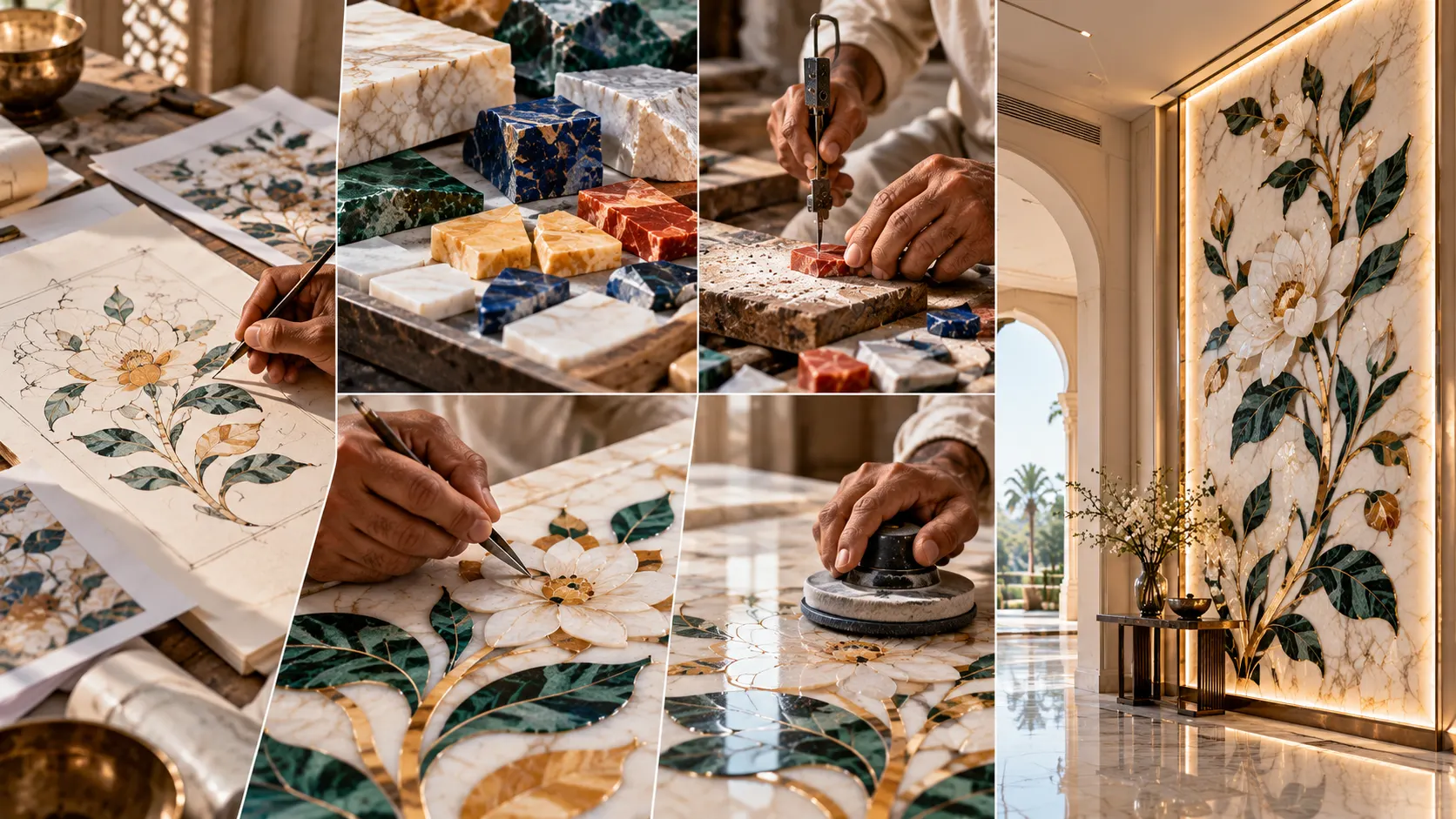
But how is marble inlay actually made? What happens between the first design sketch and the final installation? The process involves several carefully coordinated stages, including design development, stone selection, precision cutting, surface preparation, fitting, finishing and installation.
Understanding these stages reveals why handcrafted marble inlay is valued not simply for its appearance, but also for the skill and attention to detail required to create it.
Understanding the Art of Marble Inlay
Marble inlay is a decorative technique in which carefully shaped pieces of coloured stone are fitted into a prepared base, usually marble, to create a pattern or image. The pieces are positioned within corresponding recesses and secured to form an integrated composition.
The technique is associated with Pietra Dura, a term originating in Italy that refers to decorative work using hard, coloured stones. In India, the related tradition is widely known as Parchin Kari or Parchinkari.
Indian marble inlay is particularly recognised for its floral motifs, botanical patterns, ornamental borders and intricate geometric designs. These compositions rely on the natural colours of the selected stones rather than painted or printed decoration.
The process requires a combination of artistic judgement and technical skill. Artisans must understand the characteristics of different stones, the geometry of the design and the precision required to fit each individual piece.
Although traditional patterns remain popular, contemporary marble inlay also embraces simplified forms, abstract compositions and designs developed specifically for modern interiors.
The result is a craft that connects historical techniques with evolving architectural requirements.
Comparing the Main Stages of Marble Inlay Production
Each stage contributes a different element to the completed artwork.
| Stage | Main activity | Why it matters |
|---|---|---|
| Design development | Creating and refining the pattern | Establishes composition, proportions and dimensions |
| Material selection | Choosing marble and coloured stones | Determines colour, texture and material suitability |
| Stone cutting | Shaping individual pieces | Creates the elements required for the design |
| Surface preparation | Creating recesses in the base | Allows accurate fitting of the inlay |
| Fitting and securing | Positioning and fixing each piece | Brings the individual elements together |
| Finishing | Smoothing and polishing the surface | Creates the intended appearance |
| Quality inspection | Checking the completed work | Identifies inconsistencies before installation |
| Installation | Positioning the finished piece in its setting | Integrates the artwork with the architecture |
The time and effort required at each stage depend on the size, complexity, materials and installation requirements of the project.
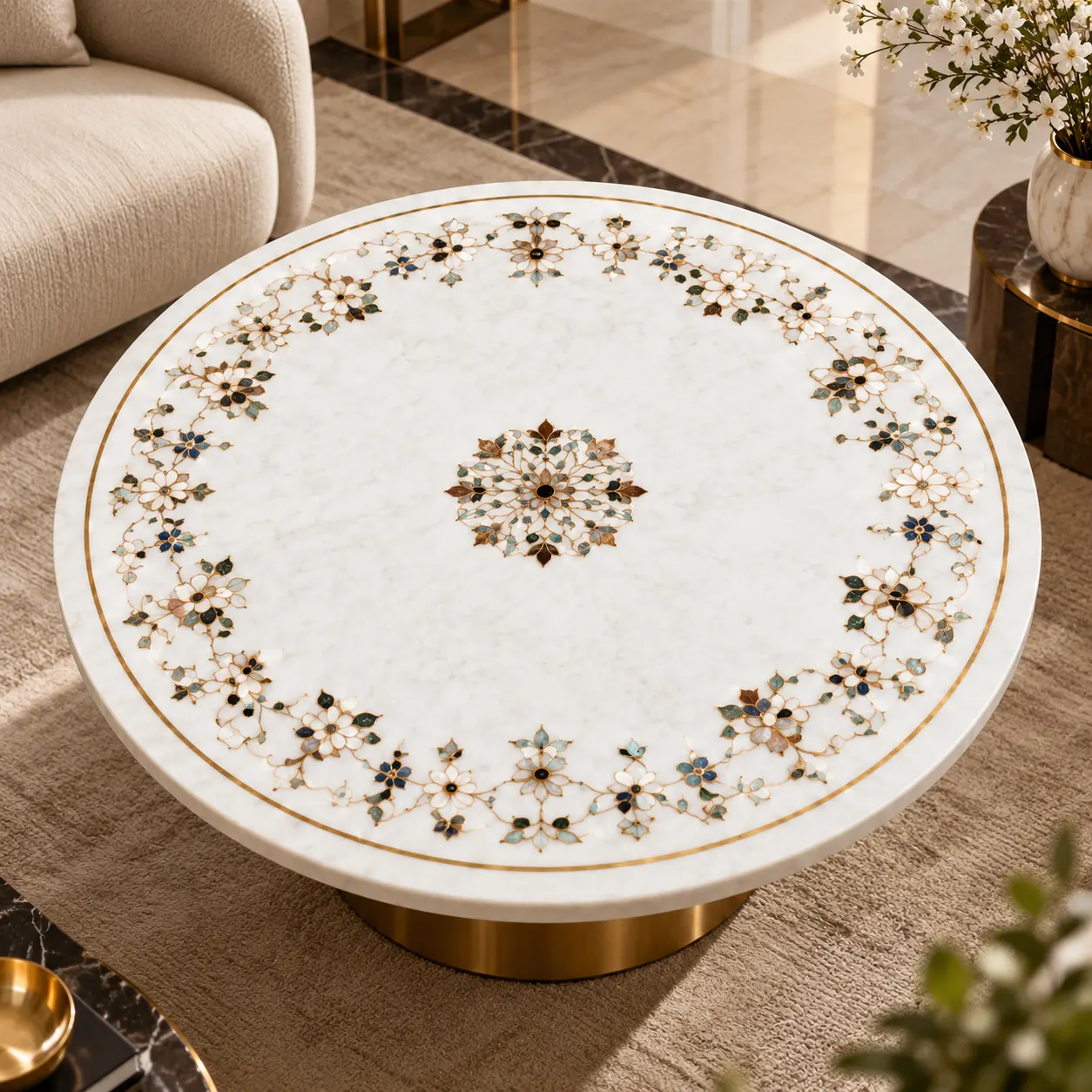
Handcrafted Marble Table Top
Discover handcrafted marble inlay table tops featuring intricate stone patterns and timeless artistry for luxury homes, bespoke furniture, and refined interiors.
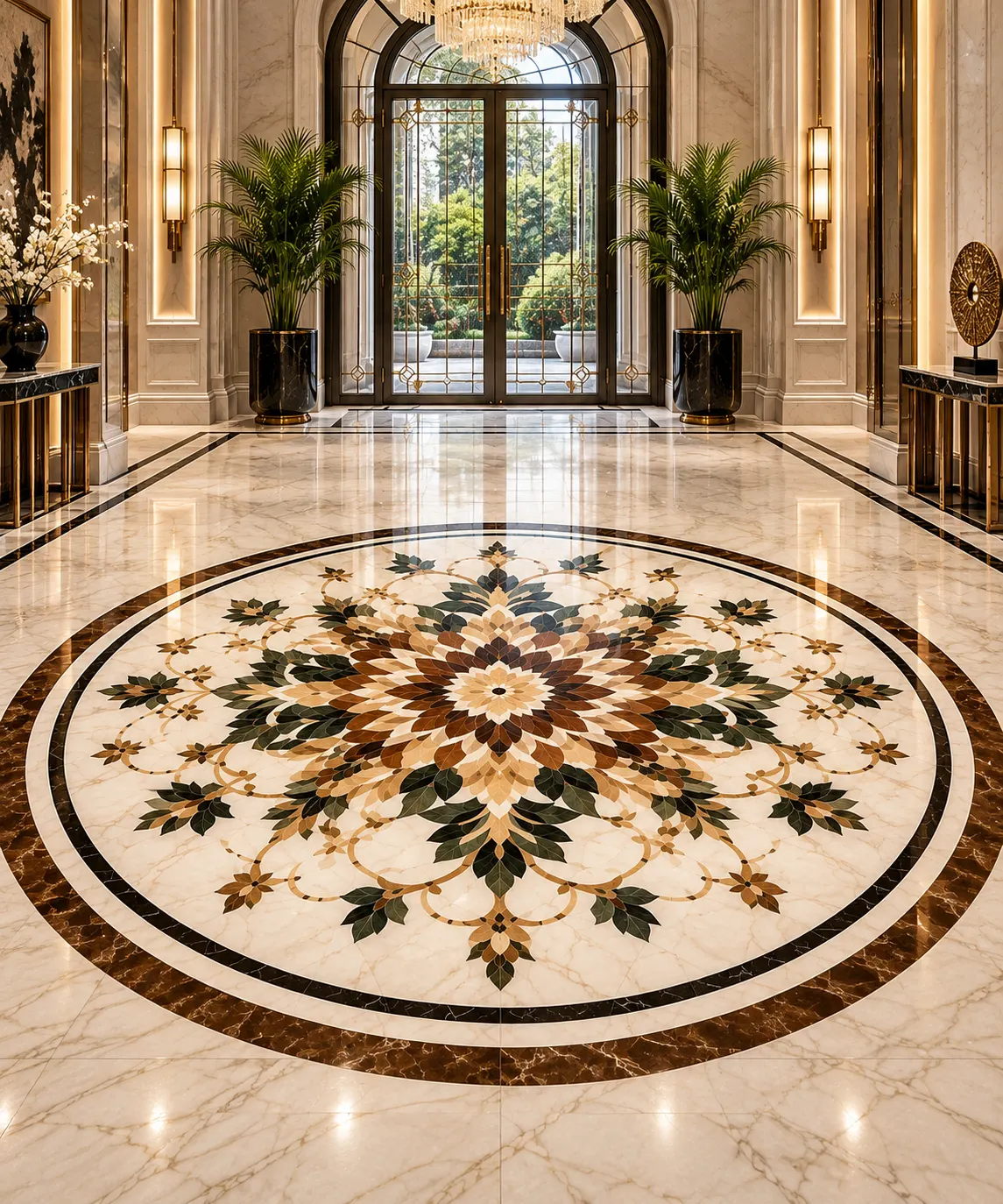
Marble Floor Inlay Art
Explore decorative marble floor inlay designs combining precision-cut natural stones and artistic patterns for elegant residences, luxury hospitality spaces, and architectural interiors.

Marble Inlay Wall Art
Transform interior spaces with artistic marble inlay wall panels and decorative stone compositions, thoughtfully designed for statement walls and sophisticated luxury interiors.
A Brief History of Marble Inlay Craftsmanship in India
Marble inlay became particularly prominent in India during the Mughal period, when rulers commissioned elaborate monuments featuring marble architecture and intricate decorative details.
Agra became closely associated with this tradition. The Taj Mahal, constructed under Emperor Shah Jahan during the seventeenth century, is among the most celebrated examples of architectural marble inlay.
Its white marble surfaces feature detailed floral compositions created from carefully selected coloured stones. These designs demonstrate the precision with which individual pieces can be incorporated into a larger architectural scheme.
The Tomb of Itimad-ud-Daulah in Agra also showcases sophisticated decorative inlay work and illustrates the importance of stone craftsmanship in Mughal architecture.
Over generations, artisans developed and preserved specialist skills in cutting, shaping and fitting coloured stones. These techniques continue to influence marble inlay work produced in and around Agra.
Today, the craft is used in applications ranging from traditional decorative objects to bespoke architectural surfaces. While the tools and working conditions may vary, the fundamental principles of design accuracy, material selection and careful finishing remain essential.
Step 1: Design Development and Planning
Every marble inlay project begins with a design.
Before any stone is cut, the intended composition must be established. The design may feature flowers, leaves, vines, birds, geometric shapes, ornamental borders or contemporary abstract patterns.
The design process involves more than creating an attractive image. It must account for the dimensions of the surface, the scale of individual details, the colours available in natural stone and the intended application.
Developing the Pattern
Traditional designs may draw inspiration from Mughal floral artwork, botanical forms and symmetrical arrangements. Contemporary projects may use cleaner lines, abstract motifs or patterns that complement modern architecture.
For a marble inlay wall panel, the composition may be developed around the proportions of the wall. A floor medallion may require a carefully balanced circular arrangement, while a tabletop design must relate to the furniture’s shape and dimensions.
Preparing the Design for Execution
Once the concept is approved, the design is refined into a more detailed working pattern. Individual components are identified so that they can be cut and fitted accurately.
For architectural projects, the planning stage may also include panel divisions, edge details, installation clearances and the relationship between the inlay and surrounding surfaces.
A well-developed design helps guide every subsequent stage and reduces the likelihood of inconsistencies during production and installation.
Step 2: Selecting the Marble and Coloured Stones
Material selection is one of the most important aspects of handcrafted marble inlay.
The marble base establishes the background, while the coloured stones create the details of the composition. Their colours, patterns, textures and physical characteristics influence both the appearance and suitability of the finished work.
Choosing the Marble Base
White marble is often selected for its ability to provide a light background against which coloured stones stand out. Beige and darker marbles can create different effects, depending on the design.
The choice should consider the intended visual character, the dimensions of the piece and the requirements of its application.
Selecting Decorative Stones
Different stones offer different colours and natural characteristics. Depending on the design, artisans may use materials such as:
- Lapis lazuli: For rich blue details and contrasting accents.
- Green aventurine: For green tones in botanical compositions.
- Jasper: For a variety of natural colours and decorative details.
- Carnelian: For reddish-orange accents.
- Onyx: For distinctive colour variations and patterns.
- Mother of pearl: For selected details that benefit from its iridescent appearance.
Not every material is appropriate for every project. The selection must consider its physical properties, compatibility with the marble base, availability and intended use.
For example, a tabletop and an architectural floor may require different considerations in terms of surface performance and maintenance.
The objective is to create a balanced material palette in which every stone contributes to the overall composition.
Step 3: Cutting and Shaping Individual Stone Pieces
After the materials have been selected, the coloured stones are cut into individual pieces corresponding to the design.
This is one of the most demanding stages of the marble inlay process because each piece must match its intended shape and fit closely with the surrounding elements.
A floral composition may contain separate pieces for petals, leaves, stems and other decorative details. Curved shapes and narrow elements require particular care because even small differences can affect the finished pattern.
Depending on the design and workshop, artisans may use specialist cutting tools, precision equipment and manual finishing techniques.
The process must account for the thickness of the stone, the shape of the component and the requirements of the final installation.
Each piece is checked against the design before it is fitted into the marble base.
Why Precision Matters
The quality of marble inlay depends significantly on the relationship between adjacent pieces. Poorly shaped elements can create uneven gaps, interrupt the design or make the composition appear inconsistent.
Precise cutting helps maintain the clarity of the pattern and allows the natural colours of the stones to work together as intended.
This stage illustrates how technical accuracy supports artistic expression.
Step 4: Preparing the Marble Surface
Once the individual stones have been shaped, the marble base must be prepared to receive them.
The design is transferred onto the surface, marking the positions and outlines of the inlay elements. Recesses are then created to accommodate the corresponding pieces.
Each recess must be appropriate to the shape and thickness of the stone being fitted. The preparation requires care because inconsistencies in depth or outline can affect the alignment and final finish.
For a detailed floral panel, the recesses must follow the contours of numerous individual elements. A geometric composition may require a different pattern of straight lines, angles and repeated shapes.
The objective is to prepare a base that allows the stones to fit accurately while preserving the intended composition.
For larger architectural pieces, the preparation stage must also consider the overall dimensions, edges and any divisions required for transport or installation.
Step 5: Fitting and Securing the Inlay
With the base prepared, the individual stone pieces can be positioned within their corresponding recesses.
Each element is carefully fitted and checked against the surrounding pieces. The artisan assesses alignment, spacing, colour relationships and the continuity of the overall design.
Suitable fixing materials and methods are selected according to the stones, base material and intended application.
This stage requires considerable patience. A complex composition may contain many individual pieces, each contributing to a larger image or pattern.
A small adjustment to one element may influence the appearance of the neighbouring pieces. Careful fitting helps maintain the precision and balance established during the design stage.
Bringing the Composition Together
As the individual stones are fitted, the design begins to emerge as a unified artwork.
The contrast between the marble background and the coloured stones creates the visual structure of the composition. The arrangement of shapes, colours and lines determines how the eye moves across the finished surface.
This is where the original design and the artisan’s technical skill come together.
Step 6: Surface Finishing and Polishing
After the inlay pieces have been secured, the surface undergoes finishing to achieve the intended appearance.
The finishing process may involve levelling, smoothing and polishing, depending on the materials and the requirements of the project.
The objective is to create a consistent surface while preserving the clarity of the inlay design. The marble background and coloured stones should work together visually, without distracting irregularities in the finish.
Care must be taken to use suitable methods for the particular stones involved. Different materials may respond differently to polishing and other finishing treatments.
Quality Inspection
The finished piece is inspected for several factors, including:
- Alignment and fit of individual stone pieces.
- Consistency of the surface finish.
- Clarity of the overall design.
- Visible gaps or imperfections.
- Suitability for the intended application.
For architectural work, the inspection may also include dimensions, edge conditions and details relevant to installation.
Quality control helps ensure that the finished marble inlay reflects the intended design and is appropriate for its final setting.
Step 7: From the Workshop to Architectural Installation
Creating the marble inlay is only part of the process when the artwork is intended for an architectural space.
A completed panel or floor element must be transported, positioned and installed appropriately. These activities require planning, particularly when working with large stone surfaces or detailed custom compositions.
Marble Inlay Wall Panels
Wall panels must be designed with the available wall dimensions, supporting structure, fixing method and installation access in mind.
Large panels may require careful planning for handling and positioning. The final installation should align with the architectural layout and surrounding finishes.
Marble Inlay Flooring
Flooring requires particular attention to the supporting base, levels, joints and traffic conditions.
The layout must be coordinated with the surrounding floor so that the decorative composition fits correctly within the overall design. Appropriate installation methods are essential to the performance of the finished surface.
Marble Inlay Tabletops
Tabletops require consideration of their dimensions, edges, support structure and intended use.
The inlay must be integrated into the furniture design, and the surface finish should be appropriate for everyday handling and cleaning.
Across all three applications, accurate measurements and early coordination help reduce installation difficulties and support a consistent final result.
What Influences the Quality of Handcrafted Marble Inlay?
Although marble inlay is often appreciated for its visual beauty, the quality of the finished work depends on several factors working together.
Design accuracy: A well-planned composition establishes the proportions and relationships between individual elements.
Material selection: The marble and coloured stones must suit the design and the intended application.
Precision of cutting: Carefully shaped pieces help maintain the clarity and consistency of the pattern.
Quality of fitting: Close-fitting elements contribute to a refined appearance and a coherent composition.
Surface finishing: Appropriate finishing methods help achieve the intended texture and visual continuity.
Installation planning: Accurate measurements, suitable fixing methods and proper preparation of the supporting surface are essential for architectural applications.
No single factor determines quality on its own. The finished work reflects the combined effect of design, materials, craftsmanship and installation.
“The beauty of marble inlay lies in the precision of every detail, where individual pieces of stone become part of a greater artistic vision.”
This is what makes the technique distinctive: each element has a specific role, yet the completed composition is experienced as a unified work of art.
Marble Inlay in Contemporary Luxury Interiors
The principles of traditional marble inlay continue to inform contemporary interior design, where natural materials and bespoke details are often used to establish a distinctive atmosphere.
Custom Marble Inlay Flooring
Decorative flooring can incorporate floral medallions, geometric patterns and ornamental borders. The design can be developed around the proportions of an entrance, living area or other architectural space.
Marble Inlay Wall Art
Custom wall panels can introduce detailed artwork into living rooms, entrance halls, formal dining areas and hospitality interiors.
The pattern and material palette may draw on traditional designs or use contemporary forms to complement the surrounding architecture.
Handcrafted Marble Inlay Tabletops
Tabletops combine decorative artistry with a functional surface. A carefully considered design can complement the furniture’s shape, dimensions and surrounding materials.
Bespoke Architectural Elements
Marble inlay can also be considered as part of a larger design scheme, with coordinated patterns across different surfaces or a single installation serving as a focal point.
In each case, the most successful approach considers the artwork in relation to the whole space rather than treating it as an isolated decorative feature.
Zenvira Atelier: Marble Inlay for Refined Architectural Spaces
Rooted in Agra, India, Zenvira Atelier focuses on marble inlay for walls, floors and tabletops, bringing the visual language of traditional stone craftsmanship into contemporary interiors.
The atelier’s design approach centres on the relationship between natural materials, artistic composition and architectural context. Each application offers different possibilities, whether through a decorative wall panel, a carefully planned floor design or a statement tabletop.
For architects, interior designers, hospitality professionals and homeowners, bespoke marble inlay provides an opportunity to introduce individual character into a project while maintaining a connection to India’s rich artistic heritage.
At Zenvira Atelier, the enduring appeal of marble inlay lies in the combination of natural stone, thoughtful design and attention to detail. Understanding the journey from design development to handcrafted installation helps reveal the skill and planning behind every completed composition.
“When craftsmanship meets the natural character of stone, a surface becomes more than a material—it becomes an expression of art.”
Explore marble inlay possibilities for your next interior project, from decorative wall panels and custom flooring to handcrafted tabletops.
Discover Zenvira Atelier: https://zenviraatelier.com/
For project enquiries, visit the website to connect with the atelier and discuss your marble inlay requirements.
FAQ’s
1. How is marble inlay art made in India?
Ans- Marble inlay art in India is created through a traditional handcrafted process involving design preparation, stone selection, precision cutting, carving, fitting, bonding and polishing. Skilled artisans carefully shape coloured natural stones and semi-precious materials before embedding them into a marble surface. This technique, closely associated with Pietra Dura craftsmanship, is widely used to create decorative wall panels, luxury marble tabletops, intricate flooring and architectural artwork.
2. What are the main steps involved in making marble inlay art?
Ans- The traditional marble inlay-making process generally involves several important stages:
-
Design Preparation: Creating floral, geometric or customised artistic patterns.
-
Stone Selection: Choosing suitable marble, coloured stones and decorative materials.
-
Precision Cutting: Shaping individual stone pieces according to the design.
-
Marble Carving: Creating carefully measured recesses in the marble base.
-
Stone Inlay: Fitting and securing the decorative stones into the carved surface.
-
Polishing and Finishing: Refining the surface to achieve a smooth, elegant appearance.
-
Installation: Positioning and securing the completed artwork in its intended architectural setting.
3. Which stones are used in traditional Indian marble inlay art?
Ans- Traditional Indian marble inlay commonly incorporates white marble, black marble, lapis lazuli, malachite, agate, jasper, onyx, turquoise and other coloured natural stones. Mother-of-pearl may also be incorporated into decorative compositions. The selection depends on the artistic design, desired colour combinations, durability requirements and intended application.
4. Why is Agra famous for marble inlay craftsmanship?
Ans- Agra is internationally recognised for its marble inlay craftsmanship because of its historical association with Mughal architecture, particularly the Taj Mahal. The monument features elaborate floral and geometric stone inlay decorations that demonstrate exceptional artistic precision. Generations of skilled artisans in Agra have preserved and developed these traditional techniques, making the city an important centre for handcrafted marble inlay artwork in India.
5. How long does it take to make handcrafted marble inlay art?
Ans- The production time depends on the artwork’s size, design complexity, number of individual stone pieces and level of customisation. Small decorative pieces may take several days, while intricate marble inlay wall panels, large tabletops and detailed flooring compositions may require several weeks or longer. Highly customised architectural installations can involve additional time for design approvals, fabrication, transportation and installation.
6. What is the difference between handmade marble inlay and machine-made marble inlay?
Ans- Handmade marble inlay involves artisans manually cutting, shaping, fitting and finishing individual stone pieces using traditional tools and techniques. Machine-assisted marble inlay may use computer-controlled cutting equipment to improve consistency and production efficiency. Handmade work is particularly valued for its craftsmanship and intricate detailing, while machine-assisted methods can be useful for precise, repeatable patterns. Both approaches can produce high-quality results depending on the materials and workmanship.
7. Can traditional marble inlay designs be customised for modern interiors?
Ans- Yes. Traditional Indian marble inlay can be adapted to suit contemporary architectural and interior design styles. Customisation options include minimalist geometric patterns, modern floral compositions, abstract artwork, personalised motifs and distinctive natural stone combinations. Bespoke marble inlay is particularly suitable for luxury wall panels, statement flooring, dining tabletops, reception areas and decorative architectural installations.
8. How is marble inlay flooring and wall art installed?
Ans- Marble inlay installation depends on the artwork’s dimensions, weight, substrate and intended location. Flooring installations require a properly prepared and level base, suitable bonding materials, accurate alignment and appropriate joint treatment. Marble inlay wall panels may require specialised mechanical supports or engineered fixing systems, particularly for large or heavy pieces. Professional installation helps ensure structural stability, precise positioning and long-term performance.
9. How durable is handcrafted marble inlay art?
Ans- Well-crafted marble inlay can remain beautiful for generations when suitable materials, installation techniques and maintenance practices are used. Durability depends on the type of marble, inlaid stones, bonding materials, surface finish and environmental conditions. Wall panels generally experience less physical wear than flooring and tabletops. Regular cleaning with pH-neutral products and appropriate surface protection can help preserve the artwork’s appearance.
10. Where can you find handcrafted and bespoke marble inlay art in India?
Ans- Agra is one of India’s most recognised destinations for traditional marble inlay and Pietra Dura craftsmanship. Architects, interior designers, homeowners and hospitality professionals can explore specialist ateliers offering customised marble inlay wall panels, decorative flooring, floor medallions and luxury tabletops.
Zenvira Atelier, based in Agra, India, focuses on bespoke marble inlay for walls, floors and tabletops. The atelier brings together traditional Indian stone artistry and contemporary design concepts to create refined decorative solutions for luxury residential, hospitality and architectural interiors.
Explore the collections at www.zenviraatelier.com.